
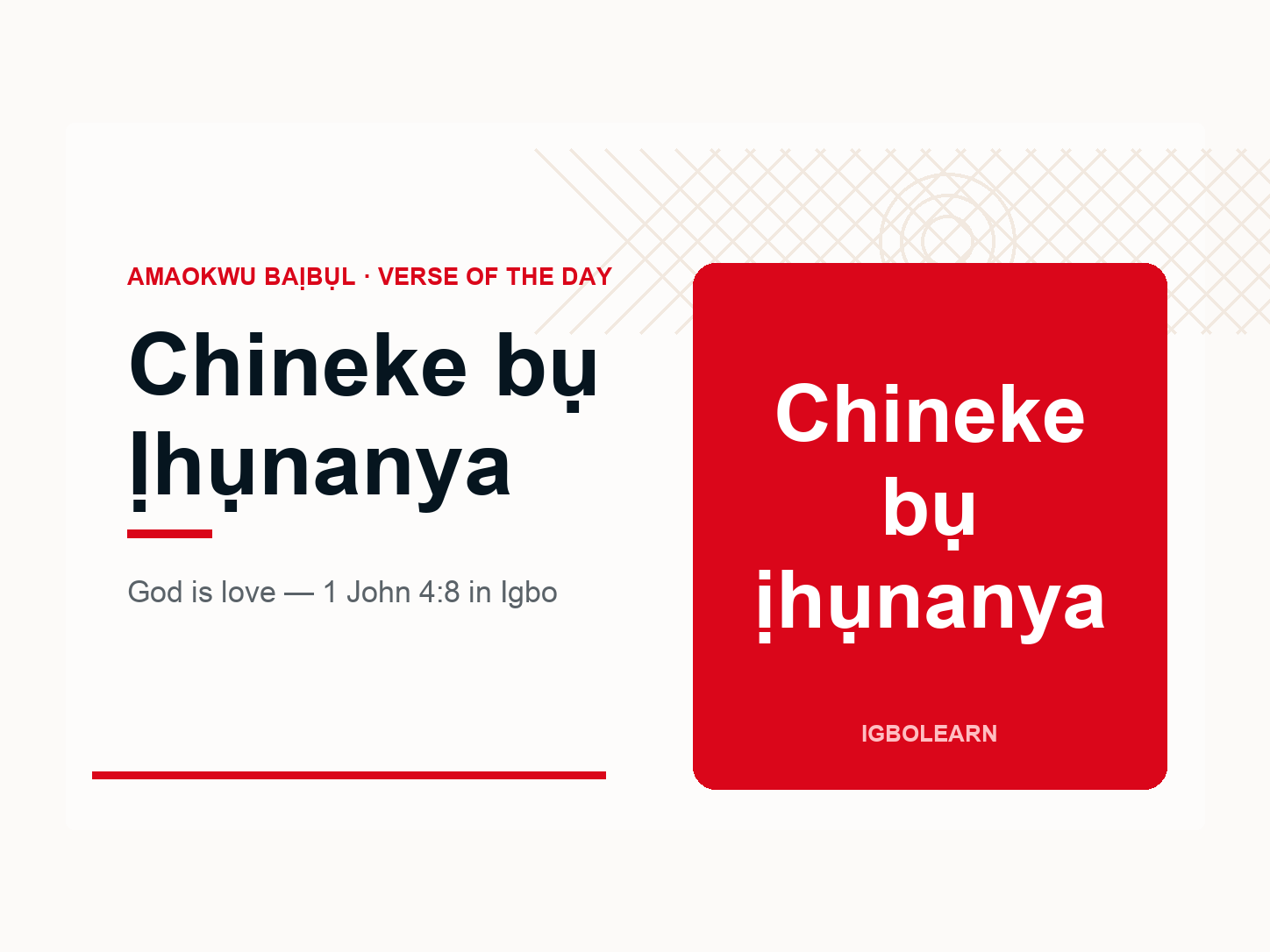
Onye na-enweghị ịhụnanya amaghị Chineke, nʼihi na Chineke bụ ịhụnanya.
He that loveth not knoweth not God; for God is love. — 1 John 4:8, or 1 Jọn as the Igbo Bible has it.
It is a famous verse in any language. In Igbo it also happens to be an unusually good grammar lesson, because almost everything a beginner struggles with is sitting in this one sentence.
The verse, word by word
| Igbo | English |
|---|---|
| onye | person; the one who |
| na-enweghị | does not have |
| ịhụnanya | love |
| amaghị | does not know |
| Chineke | God |
| nʼihi na | because |
| bụ | is |
Read straight through: the one who does not have love does not know God, because God is love.
The suffix that appears twice
Look at the two verbs again:
- nwe — to have → enweghị — does not have
- ma — to know → amaghị — does not know
The same ending does the job both times: -ghị. That is the Igbo negative. English needs a separate word — not — and has to shuffle in a helper verb to carry it. Igbo attaches the negation to the end of the verb and leaves the sentence otherwise intact.
This is the single highest-value thing to take from the verse. Learn to hear -ghị and you can tell whether an Igbo sentence is saying yes or no, even when you do not know the verb.
Ịhụnanya is not really one word
Ịhụnanya is the Igbo for love. But it is built out of a small sentence, and the sentence is to see in the eyes: ịhụ, to see, plus nʼanya, in the eye.
Which means that when the verse says Chineke bụ ịhụnanya, the word it reaches for is not an abstraction about feeling. It is about being seen, and seeing. That is a different image from the English love, and it is worth sitting with.
We have written about this elsewhere, because it is the same construction behind the most common phrase in the language: see how to say I love you in Igbo.
And Chineke
Chineke is itself a compound: Chi, the creator spirit, joined with eke, to create or apportion. God who creates.
Chi is one of the deepest words in the language and it long predates its use in the Igbo Bible. It turns up constantly in names — Chinedu, Chiamaka, Chukwuemeka — where it carries the sense of a personal divine portion, the share of God that belongs to one person.
So the closing clause, Chineke bụ ịhụnanya, stacks two compounds against each other: the one who creates is the seeing-in-the-eyes. The Igbo is doing more work than the English translation lets on.
Saying it out loud
Two things learners trip over here.
- The dotted letters — ị, ụ, ọ — are their own vowels, not decorated versions of i, u and o. Ịhụnanya has two of them.
- That mark in nʼihi and nʼanya is not an apostrophe doing punctuation. It marks a contraction of na, and the two words run together in speech.
A verse a day, in Igbo and English. IgboLearn carries the Igbo Bible with a verse of the day and audio for the readings, so you can follow the tones rather than guess them. Look up ịhụnanya in the dictionary, or open the free app.
Discover more from IgboLearn Blog
Subscribe to get the latest posts sent to your email.