
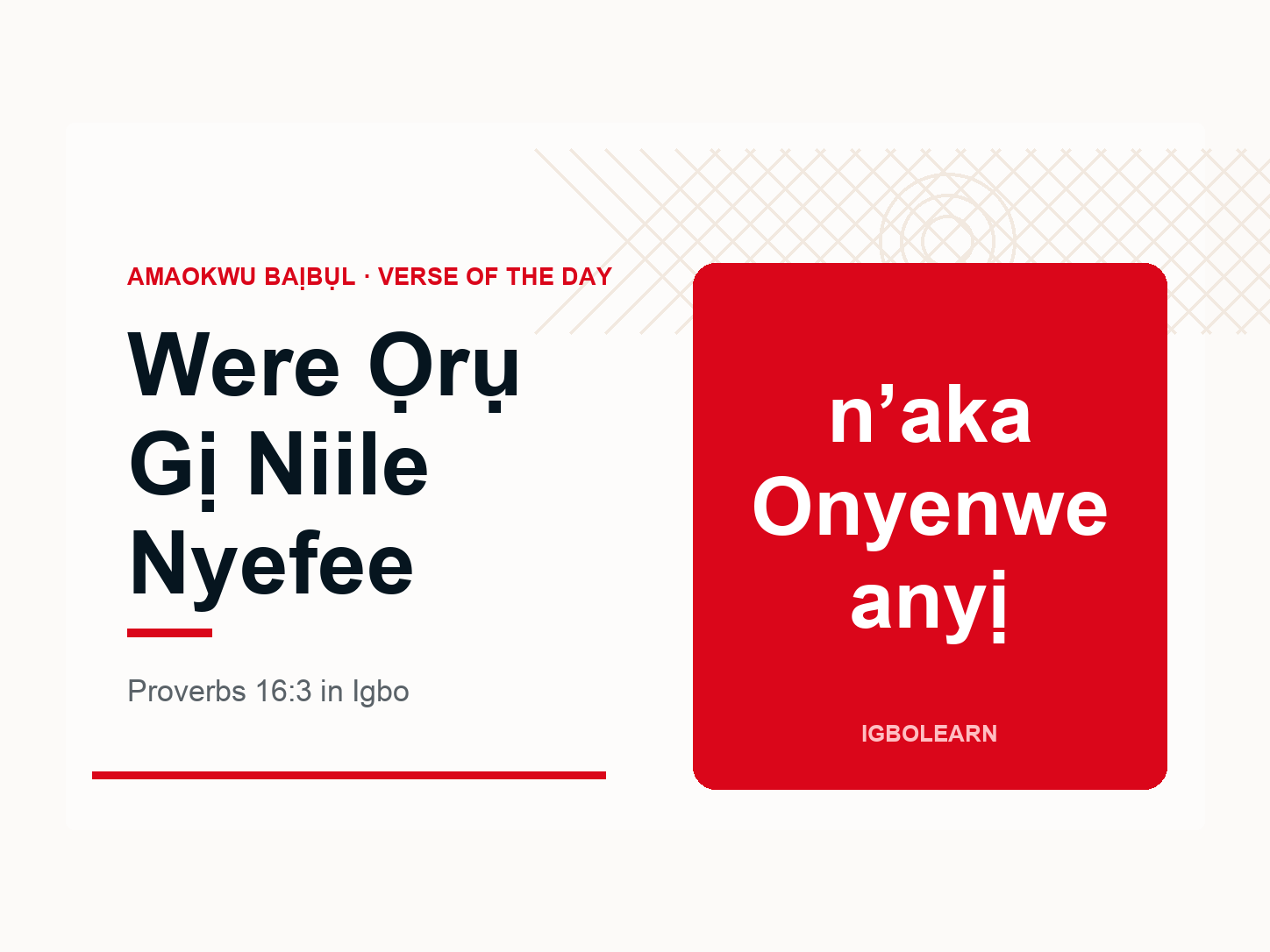
Were ọrụ gị niile nyefee nʼaka Onyenwe anyị…
Commit thy works unto the LORD, and thy thoughts shall be established. — Proverbs 16:3.
Today’s verse in the IgboLearn app. Before the verse itself, one small pleasure worth noticing.
The book is called Ilu
In the Igbo Bible, the book of Proverbs is Ilu.
Ilu is simply the Igbo word for a proverb — the ordinary, everyday word for the sayings an elder drops into an argument to settle it. The translators did not need to invent anything. Igbo already had a word for exactly this kind of writing, and a whole tradition behind it.
The verse, word by word
| Igbo | English |
|---|---|
| were | take |
| ọrụ | work; task; job |
| gị | your |
| niile | all; every |
| nyefee | hand over; commit |
| nʼaka | into the hand of |
| Onyenwe anyị | the Lord |
Read literally: take all your work and hand it over into the hand of the Lord.
Note that the Igbo is more physical than the English. Commit is an abstraction. Nyefee nʼaka is a transfer — something leaves your hands and arrives in someone else’s. Aka is the ordinary word for hand or arm, and it is doing ordinary work here.
What Onyenwe anyị actually says
This is the phrase worth taking away. The Igbo Bible’s standard rendering of the Lord is Onyenwe anyị, and it is built from three pieces:
| Part | Meaning |
|---|---|
| onye | person; the one who |
| nwe | to have; to own |
| anyị | us |
Onyenwe on its own is in the dictionary as lord, master, owner — and you will meet it in daily life as onyenwe ụlọ, the landlord, the owner of the house. Add anyị and you have the one who owns us.
That verb nwe may look familiar. It is the same one at the centre of 1 John 4:8, in na-enweghị — does not have. Learn one Igbo verb and it keeps turning up with a different coat on.
One honest note on the text
The Igbo above is the opening clause of the verse. The English carries a second half — and thy thoughts shall be established — which completes the thought: hand the work over, and what you are planning will hold.
It is worth reading both halves together. The verse is not telling you to stop working. It is telling you where to put the part of the work you cannot control.
A verse a day, in Igbo and in English. IgboLearn carries the Igbo Bible with a verse of the day and audio for the readings. Look up ọrụ or aka in the dictionary, or open the free app.
Discover more from IgboLearn Blog
Subscribe to get the latest posts sent to your email.