
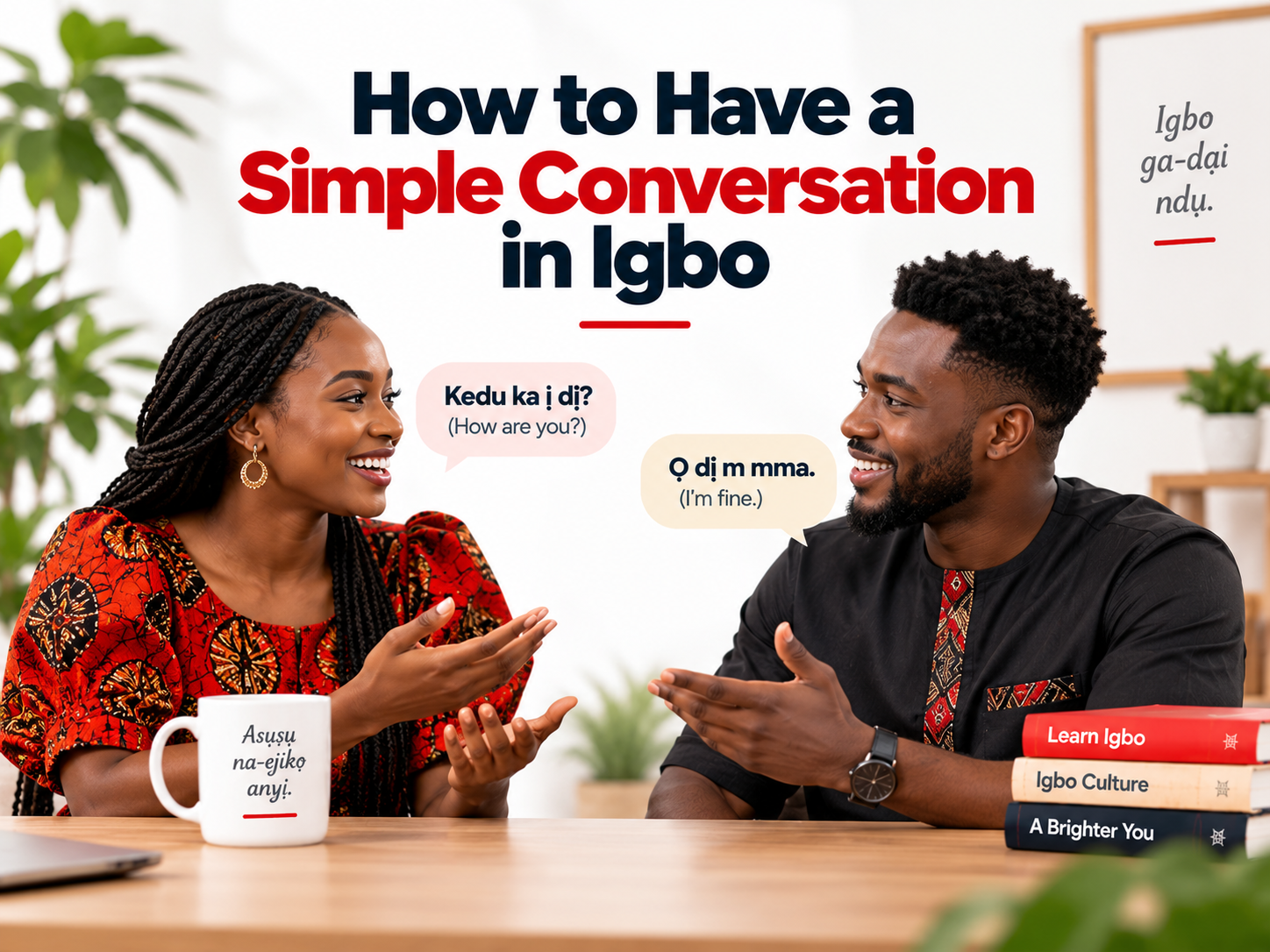
You know some Igbo words.
You know how to say hello, tell someone your name. Maybe you can even answer a few basic questions.
But can you put those things together and have a conversation in Igbo?
Learning how to have a simple conversation in Igbo is the next step.
You don’t need to start with a long conversation. You need a few useful questions, know how to answer them, and then practise going back and forth.
Let’s start with the kind of conversation you could actually have when meeting someone.
Simple Igbo Conversation: Quick Guide
If you’re scanning, start here.
| What you want to say | Igbo |
|---|---|
| Hello | Ndeewo |
| How are you? | Kedu ka ị mere? |
| I’m fine, thank you. | Adị m mma, daalụ. |
| What is your name? | Gịnị bụ aha gị? |
| My name is… | Aha m bụ… |
| Where are you from? | Ị bụ onye ebee? |
| What do you do? | Gịnị ka ị na-arụ? |
| Thank you | Daalụ |
If you remember nothing else from this page, start with these three:
Ndeewo.
Hello.
Kedu ka ị mere?
How are you?
Gịnị bụ aha gị?
What is your name?
Those three phrases already give you somewhere to start.
This topic is part of IgboLearn’s Introduction to Igbo Conversations lesson.
In the full lesson, the tutor takes you through a complete conversation so you can hear how these questions and answers work together.

👉 Continue the Introduction to Igbo Conversations lesson on IgboLearn
Start Your Igbo Conversation With a Greeting
You meet someone. What do you say first?
Start simply:
Ndeewo.
Hello.
The other person can respond:
Oo, ndeewo.
Yes, hello.
Now you have a conversation.
A very short one, yes.
But you’ve started.
From there, you can ask how the person is doing.
Kedu ka ị mere?
How are you?
And they might answer:
Adị m mma, daalụ.
I am fine, thank you.
Notice what we’re doing here.
We’re not learning ten different greetings before you’re allowed to speak.
You’re learning one exchange you can actually use:
Kedu ka ị mere?
How are you?
Adị m mma, daalụ.
I am fine, thank you.
Practise those together rather than as two unrelated phrases.
How Do You Ask Someone’s Name in Igbo?
Once you’ve greeted someone, you may want to introduce yourself.
You can say:
Aha m bụ Emeka.
My name is Emeka.
Change Emeka to your own name.
Then, if you want to ask the other person’s name:
Gịnị bụ aha gị?
What is your name?
Put them together:
Aha m bụ Emeka. Gịnị bụ aha gị?
My name is Emeka. What is your name?
This is where vocabulary starts becoming conversation.
You’re no longer memorising the Igbo word for name.
You’re using Igbo to introduce yourself and ask someone a question.
Try it with your own name
Complete this:
Aha m bụ ________.
My name is ________.
Say it aloud.
Then ask:
Gịnị bụ aha gị?
What is your name?
That’s a conversation you can practise immediately.
How Do You Ask Where Someone Is From in Igbo?
After exchanging names, you might want to know where someone is from.
One of the questions used in the lesson is:
Ị bụ onye ebee?
Where are you from?
An answer might be:
Abụ m onye Enugu Steeti.
I am from Enugu State.
The useful part is that you can make the answer relevant to you.
Instead of memorising Enugu State because that’s what appears in the lesson, practise answering with where you’re actually from.
Start with:
Abụ m onye…
I am from…
Then complete it with your own answer.
That’s more useful than memorising someone else’s introduction.
Turn Igbo Phrases Into a Real Exchange
So far, you can already do quite a bit.
You can:
Say hello.
Ask how someone is.
Say your name.
Ask their name and where they’re from.
That’s the beginning of an actual conversation.
And there’s more you can ask.
The full lesson continues the conversation into school and what someone does, then shows you how the exchange can come to a natural end.
I’m deliberately not reproducing the entire conversation here.
Instead, when you take the lesson, listen for the point where the conversation moves from:
Who are you?
to:
What do you do?
See whether you can recognise the question before checking the English meaning.
👉 Listen to the full conversation with the tutor on IgboLearn
Don’t Learn Only One Side of the Conversation
This is important.
If you learn:
Gịnị bụ aha gị?
What is your name?
you should also practise answering it.
Aha m bụ ________.
My name is ________.
If you learn:
Kedu ka ị mere?
How are you?
practise:
Adị m mma, daalụ.
I am fine, thank you.
And if you learn:
Ị bụ onye ebee?
Where are you from?
Practise giving your own answer.
A conversation isn’t a vocabulary test. You need to understand what someone says and know what you can say back.
Practise a Short Igbo Conversation
Now put what you’ve learnt together.
Imagine you’ve just met someone.
Start with:
Ndeewo.
Hello.
Then:
Kedu ka ị mere?
How are you?
Then introduce yourself:
Aha m bụ ________.
My name is ________.
And ask:
Gịnị bụ aha gị?
What is your name?
Then:
Ị bụ onye ebee?
Where are you from?
That’s enough for one practice session.
Don’t worry about making the conversation longer until you can say the shorter version comfortably.
Then add another question.
And another.
Your Turn
Let’s see if you can answer one question without looking back.
Gịnị bụ aha gị?
What is your name?
How would you respond?
Use:
Aha m bụ ________.
My name is ________.
Put your name in the space.
Then say the whole answer aloud.
That’s much more useful than simply reading this page and moving on.
Keep Learning Everyday Igbo
Once you can introduce yourself, you can start adding vocabulary that helps you talk about everyday life.
Learn Igbo food names: foods and drinks in Igbo
Useful words for foods, soups and drinks you may want to talk about in conversation.
How to tell time and days in Igbo
Talk about today, tomorrow, parts of the day and days of the week.
Learn how to form simple sentences in Igbo
Start putting the Igbo words you know together to express complete thoughts.
Learn how to build longer sentences in Igbo
Build on simple sentences by adding more information and connecting your ideas.
Or browse all free Igbo lessons on IgboLearn and choose what you want to learn next.
Practise a Full Conversation in Igbo
The goal isn’t to memorise a script and repeat it forever.
It’s to get comfortable enough with common questions and answers that you can begin responding for yourself.
The Introduction to Igbo Conversations lesson puts these pieces into a longer exchange so you can follow the conversation with the tutor and hear how the different questions and answers work together.
You can then reinforce what you’ve learnt with IgboLearn’s audio flashcards, games, practice activities and assessment.
👉 Continue the Introduction to Igbo Conversations lesson on IgboLearn
Before you go, answer this:
Gịnị bụ aha gị?
What is your name?
Aha m bụ ________.
Now say it aloud.