
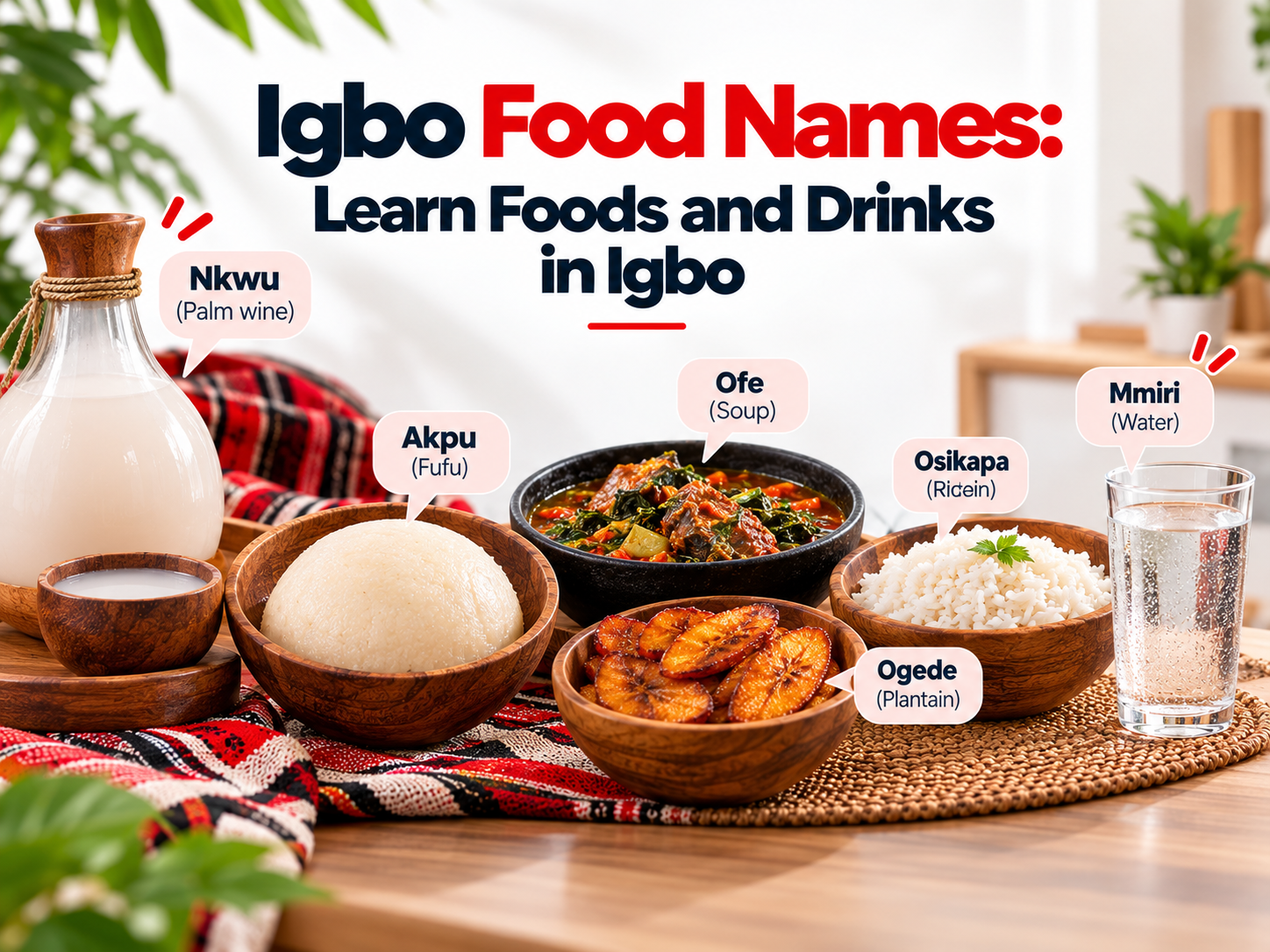
Food is one of those topics that comes up naturally in conversation.
You might want to say what you ate.
Ask for water.
Talk about your favourite soup.
Or recognise the name of a food when someone mentions it in Igbo.
So instead of trying to memorise a huge list of food vocabulary, let’s start with foods and drinks in Igbo that you can recognise and use.
Igbo Foods and Drinks: Quick Guide
If you’re scanning, start here.
| English | Igbo |
|---|---|
| Water | Mmírí |
| Rice | Òsikapa |
| Yam | Jì |
| Beans | Àgwà |
| Meat | Ànụ̄ |
| Fish | Azụ̄ |
| Palm wine | Mmanya Nkwụ |
| Oha soup | Òfé Oha |
| African salad | Àbàchá |
| Breadfruit | Ùkwà |
You don’t need to learn every Igbo food word today.
Pick a few foods you already eat or recognise and start there.
This topic is part of IgboLearn’s Introduction to Igbo Conversations lesson. In the full lesson, the tutor takes you through more Igbo words for foods, soups, delicacies and drinks.

👉 Continue the Introduction to Igbo Conversations lesson on IgboLearn
How Do You Say Food and Drink in Igbo?
The lesson introduces the topic as:
Nri na Mmanya Ndị Igbo
Igbo foods and drinks
And if you’re starting with everyday food vocabulary, there are a few words worth recognising immediately.
Òsikapa — Rice
Jì — Yam
Àgwà — Beans
Ànụ̄ — Meat
Azụ̄ — Fish
These are useful because they’re not unusual words you’re learning simply to pass a vocabulary test.
They’re foods you can actually talk about.
Start by looking at the English word and seeing whether you can remember the Igbo without checking.
Rice? Òsikapa.
Yam? Jì.
Fish? Azụ̄.
That’s already five useful food words.
Popular Igbo Soups
You can’t talk about Igbo food for very long without getting to soup.
The lesson introduces several, including:
Òfé Oha — Oha Soup
Òfé Onugbu — Bitter Leaf Soup
Òfé Egusi — Egusi Soup
Òfé Okro — Okro Soup
If some of those foods are already familiar to you, use that familiarity to your advantage.
Instead of trying to memorise a completely unfamiliar word and its English translation, you’re attaching Igbo to something you already know.
And there are more foods in the lesson, including the staple foods commonly eaten with soups.
I’ll leave that fuller list for the lesson so you have something new to work through with the tutor.
👉 Learn more Igbo food vocabulary in the full lesson
How Do You Say Water in Igbo?
Here’s one you’ll probably find useful quickly:
Mmírí — Water
Simple.
Now you’ve got a word you can listen for in everyday conversation.
The lesson also introduces different drinks, including:
Mmanya Nkwụ — Palm Wine
Palm wine is particularly useful vocabulary when you’re learning about Igbo food and culture because food and drink aren’t separated from social life.
They appear at gatherings, celebrations and ceremonies too.
Igbo Foods You Might Already Know
Some Igbo foods don’t need much introduction.
You may already know:
Àbàchá — African Salad
Òkpa — Bambara Nut Pudding
Ùkwà — Breadfruit
Ìsì Éwú — Goat Head Delicacy
Nkwọ̀bì — Spicy Cow Leg Delicacy
If you’ve eaten any of them before, here’s a simple exercise.
Don’t just read the list.
Pick your favourite.
Now try to remember its Igbo name without looking.
For example, if someone asks which you prefer:
Òfé Oha, Àbàchá or Nkwọ̀bì?
Can you recognise all three without needing the English underneath?
That’s a much more useful test than seeing whether you can memorise twenty food names at once.
Food Is Also Part of Igbo Culture
Food isn’t only something you need vocabulary for.
It’s part of gatherings and celebrations.
The lesson shows how food brings people together during occasions such as:
Nzukọ Ezinụlọ — Family Meetings
Mmemme — Festivals
Ịgba Nkwụ — Traditional Marriages
Ịgụ Aha — Naming Ceremonies
So when you learn Igbo food vocabulary, you’re also learning words connected to situations where those foods may actually be served.
The lesson even introduces an Igbo saying:
Bịa rie abụghị bịa rụọ.
Come and eat is not come and work.
I’ll leave the wider discussion around food, drinks and their place in Igbo culture for the full lesson.
Don’t Just Memorise the Food List
Try something more practical.
Look around your kitchen or think about what you ate today.
Can you identify anything using the words you’ve just learnt?
Maybe you had:
Òsikapa — Rice
Or:
Jì — Yam
Maybe you ate:
Azụ̄ — Fish
And when you’re thirsty:
Mmírí — Water
Now you’re connecting Igbo vocabulary to things already happening in your day.
That’s much easier to remember than staring at a list.
Test Yourself
Before you scroll back up, see how many you remember.
What is water in Igbo?
Say what yam is in Igbo?
What is fish?
Can you say Oha soup?
What is African salad?
Here are the answers:
Mmírí — Water
Jì — Yam
Azụ̄ — Fish
Òfé Oha — Oha Soup
Àbàchá — African Salad
If you missed one, that’s the word to go back to.
You don’t need to memorise everything at once.
Learn More Igbo Foods and Drinks
We’ve deliberately kept this guide practical.
You now have some useful Igbo words for everyday foods, soups, delicacies and drinks.
But there are more in the lesson.
In Introduction to Igbo Conversations, the tutor takes you through the fuller vocabulary, including staple foods, different soups, other common foods, delicacies and drinks.
You’ll also hear the words rather than only seeing them written down, which matters when you want to recognise and use them in conversation.
You can then use IgboLearn’s audio flashcards, games, practice activities and assessment to help you remember what you’ve learnt.
👉 Continue the Introduction to Igbo Conversations lesson on IgboLearn
For now, choose five words from this page.
Learn those first.
Then come back for five more.
Keep Learning Everyday Igbo
Food vocabulary is useful, but it’s only one part of the Igbo you’ll use in everyday conversations.
If you want to keep building from here, try these next:
Learn how to tell time and days in Igbo
How to say today, tomorrow, morning and the days of the week in Igbo.
How to form simple sentences in Igbo
Start putting the Igbo words you know together to express complete thoughts.
Learn Subject, Verb and Object in Igbo
See how the different parts of a simple Igbo sentence fit together.
Study how to build longer sentences in Igbo
Once you can make a basic sentence, learn how to add more information and connect your ideas.
Or browse all free Igbo lessons on IgboLearn to choose what you want to learn next.
Igbo ga-adị ndụ.