
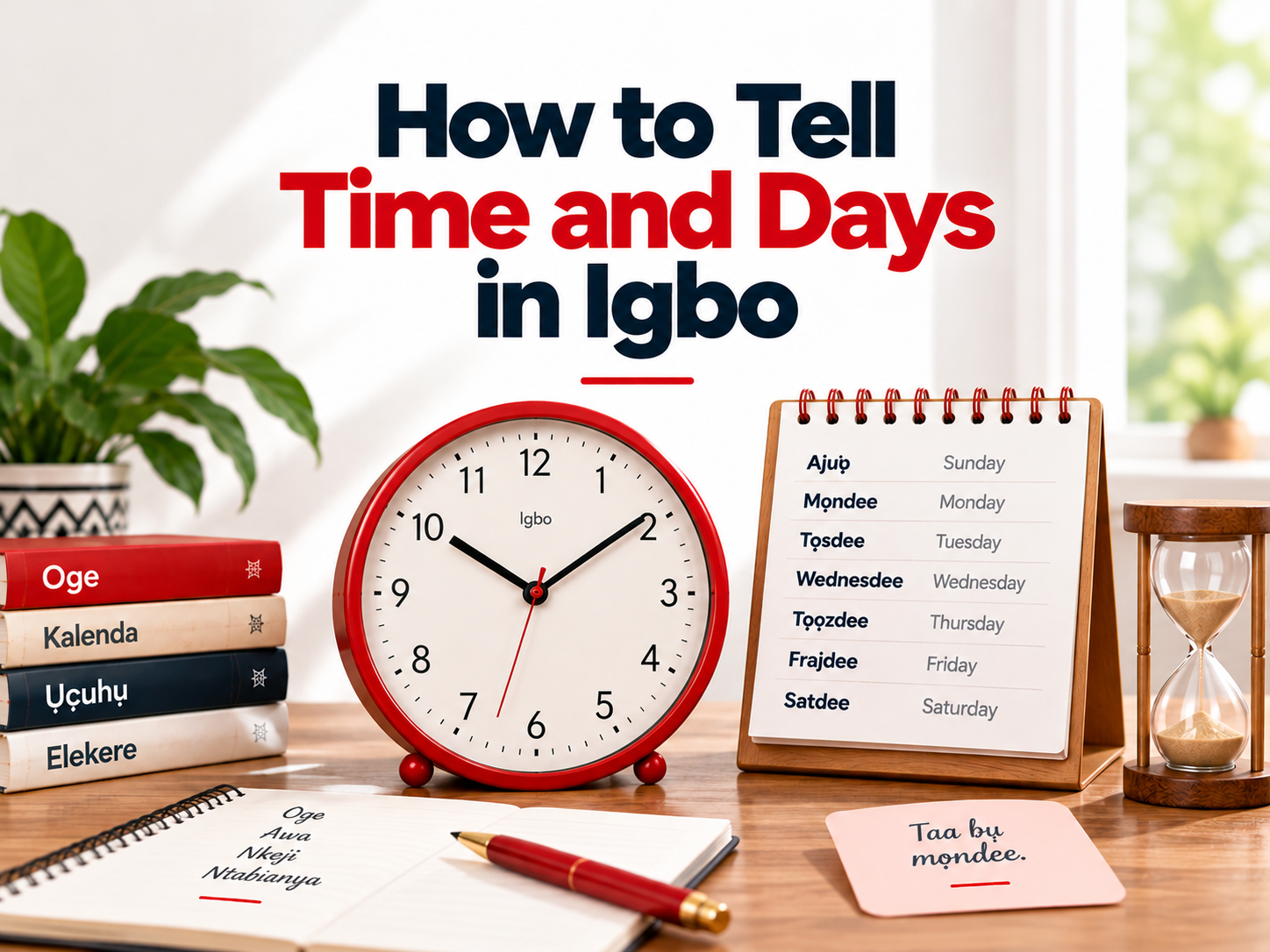
What time is it?
Is something happening today, tomorrow, or on Monday?
These are small things, but they come up all the time when you’re having a conversation.
Let’s start with some of the words you’ll use most often.
Time and Days in Igbo: Quick Guide
If you’re scanning, start here.
| English | Igbo |
|---|---|
| Time | Oge |
| Hour | Awa |
| Minutes | Nkeji |
| Morning | Ụtụtụ |
| Afternoon | Ehihie |
| Evening | Mgbede |
| Yesterday | Ụnyaahụ |
| Today | Taa |
| Tomorrow | Echi |
Three particularly useful ones to remember are:
Ụnyaahụ — Yesterday
Taa — Today
Echi — Tomorrow
Once you know these, you can start talking about when something happened or when it’s going to happen.
This topic is part of IgboLearn’s Introduction to Igbo Conversations lesson.
In the full lesson, the tutor takes you through time, different parts of the day, days of the week and traditional Igbo market days.

👉 Learn Igbo conversations for free on IgboLearn
How Do You Say Time in Igbo?
The Igbo word for time is:
Oge — Time
There are a few other useful words you’ll hear when talking about time:
Elekere — Clock
Awa — Hour
Nkeji — Minutes
Ntabianya — Second
You don’t have to memorise everything at once.
Start with the words you’re most likely to need, then learn how they’re used when you’re actually telling the time.
For example:
Ọ kụọla elekere asatọ.
It is 8 o’clock.
And:
Ọ kụọla elekere iri.
It is 10 o’clock.
Rather than giving you every time pattern here, the full lesson shows you how to tell the time with more examples, including how to talk about half past the hour.
That gives you something useful to practise when you watch:
Can you work out how to say 5:30 in Igbo?
👉 Continue the Introduction to Igbo Conversations lesson and find out
Morning, Afternoon, Evening and Night in Igbo
You won’t always need to give someone an exact time.
Sometimes saying morning, afternoon or evening tells them what they need to know.
Here are four useful words to start with:
Ụtụtụ — Morning
Ehihie — Afternoon
Mgbede — Evening
Abalị / Anyasị — Night
These are useful because everyday conversations aren’t always about exact hours.
Someone might tell you something happened in the morning.
You might arrange to do something in the evening.
Or you may simply need to understand which part of the day someone is talking about.
The lesson introduces more specific ways of talking about different periods of the day. You can learn those once these basic four feel familiar.
Yesterday, Today and Tomorrow in Igbo
Here’s another group worth remembering immediately:
Ụnyaahụ — Yesterday
Taa — Today
Echi — Tomorrow
Let’s use one in a sentence:
Anyị ga-abịa echi.
We will come tomorrow.
Now echi isn’t just a word sitting in a vocabulary list.
You can see what it does inside a sentence.
Someone tells you:
Anyị ga-abịa echi.
We will come tomorrow.
You know when they’re coming.
That’s the goal.
You don’t only want to know that echi means tomorrow. You want to recognise it when it appears in the Igbo you hear and read.
Try it
Without looking back, can you remember these?
Yesterday = ?
Today =?
Tomorrow = ?
The answers are:
Ụnyaahụ — Yesterday
Taa — Today
Echi — Tomorrow
If you got all three, keep going.
Days of the Week in Igbo
If you’re making plans, the days of the week are going to come up quickly.
Here’s a quick reference:
| English | Igbo |
|---|---|
| Sunday | Ụbọchị Sọnde |
| Monday | Ụbọchị Mọnde |
| Tuesday | Ụbọchị Tuuzdee |
| Wednesday | Ụbọchị Wenezdee |
| Thursday | Ụbọchị Tọọzdee |
| Friday | Ụbọchị Fraịdee |
| Saturday | Ụbọchị Satọdee |
Now let’s actually use one.
Kpọọ m ụbọchị Mọnde.
Call me on Monday.
That’s much more useful than simply memorising:
Ụbọchị Mọnde — Monday
Imagine someone asks you to call them later.
Not today.
On Monday.
Kpọọ m ụbọchị Mọnde.
Call me on Monday.
Try saying it aloud.
There’s Another Way of Talking About Days in Igbo
The Monday-to-Sunday week isn’t the only set of days you’ll encounter when learning Igbo.
Traditional Igbo culture also has four market days.
They are:
Ụbọchị Éké — Eke Day
Ụbọchị Òriè — Orie Day
Ụbọchị Àfọ̀ — Afo Day
Ụbọchị Nkwọ̄ — Nkwo Day
These days are an important part of Igbo tradition and business activities.
And they’re not simply cultural terms to recognise. You can encounter them inside sentences too.
For example:
Ha ga-agba egwu ụbọchị Éké.
They will dance on Eke Day.
There’s more to learn about the days and how they’re used, so we’ll leave the deeper explanation for the lesson rather than turning this into a long list to memorise.
Put the Words Into Sentences
This is the part that matters.
You could memorise:
Echi — Tomorrow
Ụbọchị Mọnde — Monday
Ụbọchị Éké — Eke Day
But try remembering them through complete thoughts instead:
Anyị ga-abịa echi.
We will come tomorrow.
Kpọọ m ụbọchị Mọnde.
Call me on Monday.
Ha ga-agba egwu ụbọchị Éké.
They will dance on Eke Day.
Now you’re doing more than collecting vocabulary.
You’re seeing how words about time and days actually appear in Igbo conversations.
If building the sentences themselves is still difficult, you can go back to our guide on how to form simple sentences in Igbo before continuing.
And if you want to understand where different parts of a sentence fit, read how Subject, Verb and Object work in Igbo sentences.
Practise What You Remember
Before you leave, try three.
How do you say:
Morning?
Tomorrow?
Minutes?
Don’t scroll up yet.
Try to remember them first.
Ready?
Ụtụtụ — Morning
Echi — Tomorrow
Nkeji — Minutes
If one didn’t stick, that’s the one to practise again.
You don’t have to memorise every time word and every day in one sitting.
Start with the ones you can use immediately.
Then add more.
Learn Time and Days With an Igbo Tutor
Knowing how to talk about time makes everyday Igbo conversations much easier.
You can understand when something is happening, talk about different parts of the day and make plans using days of the week.
This guide gives you a practical place to start, but the Introduction to Igbo Conversations lesson goes further.
In the full lesson, the tutor takes you through more of the vocabulary for telling time, shows you how time is expressed, introduces additional periods of the day, and covers both days of the week and Igbo market days.
You can then reinforce what you’ve learnt through IgboLearn’s practice activities, games, audio flashcards and assessment.
👉 Continue the Introduction to Igbo Conversations lesson for free on IgboLearn
For now, remember these three:
Ụnyaahụ — Yesterday
Taa — Today
Echi — Tomorrow
You’ll find plenty of reasons to use them.