
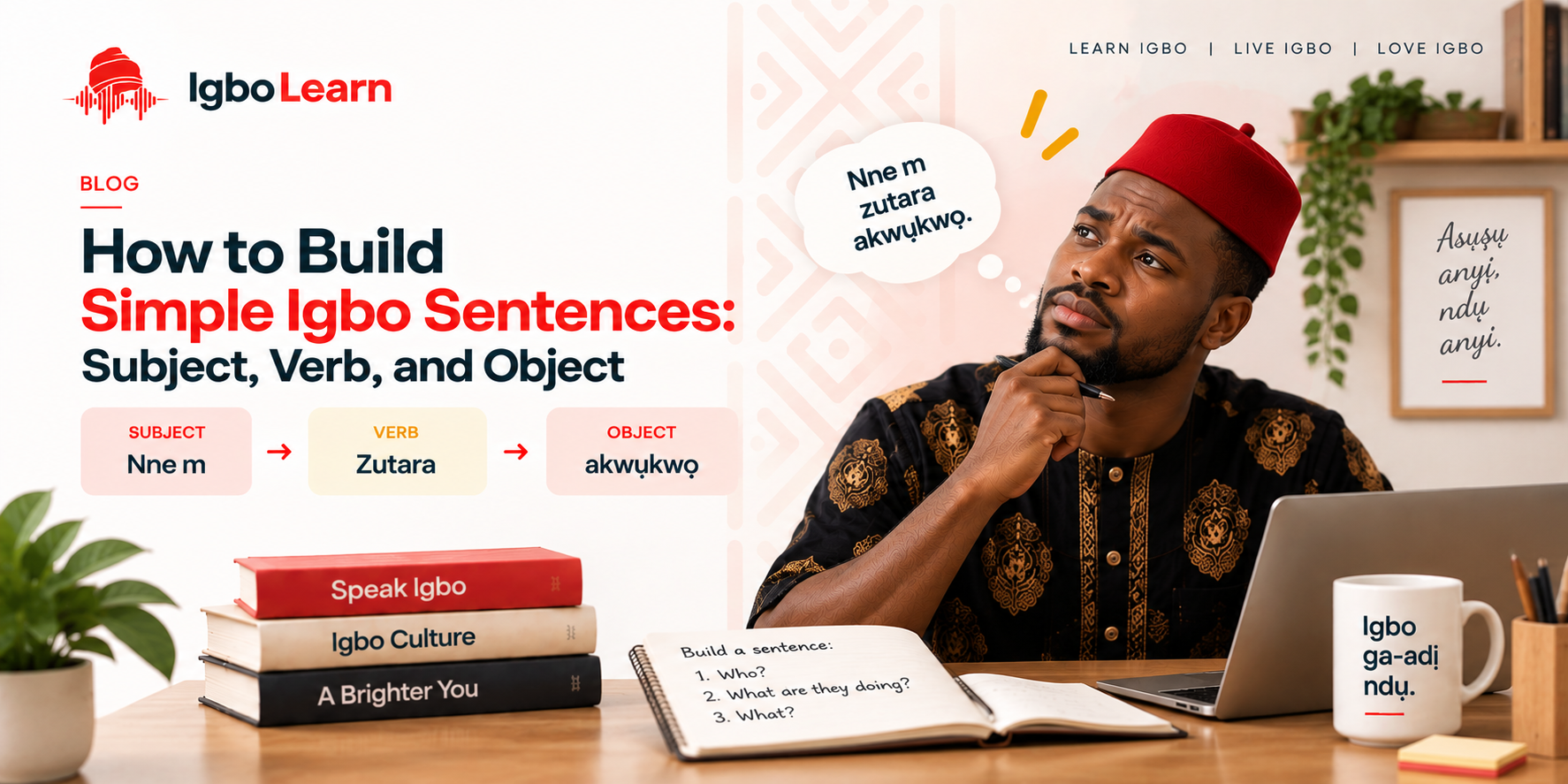
You know some Igbo words.
You may even know what different verbs and nouns mean, but when it’s time to actually build a sentence in Igbo, where does each word go? Do you know how to build simple Igbo sentences.
Do you put the action first? The person? The object?
This is where understanding Igbo sentence structure becomes useful.
If you’re completely new to sentence formation, start with our guide to how to form simple sentences in Igbo, where we look at what makes a sentence complete and why verbs matter.
One of the simplest ways to build an Igbo sentence is to think about three things:
Who or what are we talking about?
What are they doing?
What is the action being done to?
These give us Subject + Verb + Object, or SVO.
But here’s something else you need to know: not every Igbo sentence needs an object.
In this guide, we’ll look at both sentence structures taught in IgboLearn’s How to Build Igbo Sentences – Part 1 lesson: Subject + Verb + Object (SVO) and Subject + Verb (SV).
If you want to learn sentence formation step by step with an Igbo tutor, you can take the lesson on IgboLearn and practise along.

👉 Start the How to Build Igbo Sentences lesson for free
What Is the Basic Igbo Sentence Structure?
A common structure taught for simple Igbo sentences is:
Subject + Verb + Object
Or:
S + V + O
Let’s break that down.
Subject: the person or thing we’re talking about that performs the action.
Verb: the action being performed.
Object: the person or thing the action is being done to.
Take this sentence from the lesson:
Nne m zụtara akwụkwọ.
My mother bought a book.
We can break it down like this:
Nne m — Subject
zụtara — Verb
akwụkwọ — Object
So:
Nne m + zụtara + akwụkwọ.
Subject + Verb + Object.
That’s the basic pattern.
What Is the Subject in an Igbo Sentence?
The subject is the person or thing performing the action or being talked about.
In:
Nne m zụtara akwụkwọ.
My mother bought a book.
the subject is:
Nne m — My mother
Why?
Because your mother is the person performing the action.
Now look at another example from the lesson:
Chimobi riri nri.
Chimobi ate food.
The subject is:
Chimobi
because Chimobi is the person performing the action.
But here’s where it gets interesting.
The subject doesn’t have to be a person.
The Subject Doesn’t Have to Be a Person
Look at this sentence:
Ewu tara ji.
The goat ate yam.
Here:
Ewu — Subject
tara — Verb
ji — Object
The subject is ewu, meaning goat.
So the person or thing performing the action can change, but the basic pattern remains:
Subject → Verb → Object
This is much easier to understand when you see the sentences being broken down in real time. In IgboLearn’s How to Build Igbo Sentences lesson, the tutor walks through these structures and examples so you can learn how each part of the sentence works.
👉 Continue the How to Build Igbo Sentences lesson for free
What Is the Verb in an Igbo Sentence?
The Igbo word for verb is: Ngwaa
The verb tells us the action taking place.
Let’s return to:
Nne m zụtara akwụkwọ.
What’s happening?
Someone bought something.
So:
zụtara — bought
is the verb.
Now:
Chimobi riri nri.
What’s the action?
riri — ate
And:
Ewu tara ji.
The verb is:
tara
When you’re trying to understand an Igbo sentence, one useful exercise is to ask yourself:
What’s the action here?
Finding the verb can make the rest of the sentence much easier to understand.
If you’d like to spend more time learning how Igbo verbs work before building sentences with them, explore the Basic Verbs in Igbo Language course in our free Igbo lessons online.
What Is the Object in an Igbo Sentence?
The object is the person or thing the action is being done to.
Take:
Nne m zụtara akwụkwọ.
My mother bought a book.
What did she buy?
Akwụkwọ.
So akwụkwọ is the object.
Now:
Chimobi riri nri.
Chimobi ate food.
What did Chimobi eat?
Nri.
So nri is the object.
And:
Ewu tara ji.
The goat ate yam.
What did the goat eat?
Ji.
So ji is the object.
You can start seeing a simple pattern:
| Subject | Verb | Object |
|---|---|---|
| Nne m | zụtara | akwụkwọ |
| Chimobi | riri | nri |
| Ewu | tara | ji |
Instead of looking at an Igbo sentence as one long string of words, start looking for the job each word is doing.
Who or what?
Did what?
To what?
That’s your SVO structure.
Not Every Igbo Sentence Needs an Object
Now here’s the part that’s easy to miss.
You don’t always need:
Subject + Verb + Object.
Some simple Igbo sentences can have only:
Subject + Verb
Or:
S + V
The lesson gives this example:
Mmiri zoro.
It rained.
Here:
Mmiri — Subject
zoro — Verb
That’s it.
You don’t need to force another word onto the end just because you’ve learnt the SVO structure.
The sentence already communicates the thought.
Another example is:
Ngozi bịara.
Ngozi came.
Here:
Ngozi — Subject
bịara — Verb
Again:
Subject + Verb.
A complete, simple Igbo sentence.
SVO vs SV: What’s the Difference?
Let’s put the two structures side by side.
Subject + Verb + Object
Nne m zụtara akwụkwọ.
Nne m — Subject
zụtara — Verb
akwụkwọ — Object
Subject + Verb
Ngozi bịara.
Ngozi — Subject
bịara — Verb
Both structures can form simple sentences.
The difference is that the SVO structure includes an object, while an SV sentence communicates a complete thought using only the subject and verb.
So don’t fall into the trap of thinking:
Every Igbo sentence must have an object.
It doesn’t.
Sometimes: Subject + Verb is enough.
This distinction is one of the things covered in IgboLearn’s How to Build Igbo Sentences – Part 1 lesson. Instead of memorising a formula and trying to force every sentence into it, you learn how different sentence patterns work through examples.
👉 Practise Igbo sentence building with the free lesson
How Do You Add More Information to a Simple Igbo Sentence?
Once you understand the basic sentence, you can start giving the listener more information.
The lesson uses:
Mmiri zoro.
It rained.
Then expands it to:
Mmiri zoro ụnyaahụ.
It rained yesterday.
We’ve gone from a very short sentence to one that tells us more.
Mmiri zoro.
Okay, it rained.
But:
Mmiri zoro ụnyaahụ.
Now we also know when.
Yesterday.
This is how your Igbo begins to grow.
You don’t have to jump immediately from two-word sentences to complicated paragraphs.
Start with the simple thought.
Then learn how to add information.
And as you become more comfortable building sentences, you can start putting them to work in everyday situations. fFor example, when you introduce yourself in Igbo or have a simple conversation.
Practise Finding the Subject, Verb and Object
Now try it yourself.
Look at each sentence and identify the subject and verb. Then ask whether the sentence also has an object.
1. Nne m zụtara akwụkwọ.
2. Chimobi riri nri.
3. Ewu tara ji.
4. Ngozi bịara.
Try them before checking the answers.
Ready?
1. Nne m / zụtara / akwụkwọ — SVO
2. Chimobi / riri / nri — SVO
3. Ewu / tara / ji — SVO
4. Ngozi / bịara — SV
Notice that the fourth sentence doesn’t need an object to communicate a complete thought.
Now go back through the four sentences and say them aloud.
The point isn’t just to remember which one is SVO or SV.
It’s to start seeing the structure when you read or hear an Igbo sentence.
Stop Seeing Igbo Sentences as One Big Block of Words
When you’re still learning Igbo, a complete sentence can sometimes look intimidating.
You recognise one word.
Maybe two.
Then everything else starts blending together.
Breaking the sentence into parts gives you another way to approach it.
Instead of:
Nne m zụtara akwụkwọ.
being words you need to somehow remember, you can see:
Nne m → Who?
zụtara → Did what?
akwụkwọ → To what?
That’s structure.
And once you understand the structure, you can start paying attention to the same patterns when you encounter other Igbo sentences.
The goal isn’t to memorise Nne m zụtara akwụkwọ forever.
The goal is to understand why the sentence works.
Then you can begin building your own.
The same principle applies when you move into actual conversation. If you’re working on that next, our guide to common Igbo greetings and responses gives you useful phrases you can begin using with other people.
Learn How to Build Igbo Sentences Step by Step
In Topic 1, we started with what a sentence is and why the verb matters.
If you haven’t covered that yet, read How to Form Simple Sentences in Igbo first.
Now we’ve gone one step further.
You’ve learnt two simple Igbo sentence structures:
Subject + Verb + Object
and:
Subject + Verb
You’ve also learnt how to identify the subject, verb and object in simple Igbo sentences.
That’s the foundation.
The more you understand how Igbo sentences are put together, the easier it becomes to move beyond memorised vocabulary and start expressing your own thoughts.
How to Build Igbo Sentences – Part 1 includes 7 topics taught by Igbo tutor Chinyere Obiyor and is rated ⭐ 4.9/5 on the IgboLearn app.
As you continue, you’ll build on what you’ve learnt here with more sentence patterns and practical examples.
At the end of the lesson, you can complete an assessment to test what you’ve learnt. You can also use the IgboLearn app for additional practice with games, topic-based activities and audio flashcards.
👉 Continue How to Build Igbo Sentences – Part 1 for free
Then don’t just read the examples.
Find the subject. Identify the verb. Find the object when there is one.
Start paying attention to the structure of the Igbo you hear and read.
That’s how you begin moving from knowing Igbo words to building Igbo sentences.
Keep Learning Igbo
If you want to continue building your Igbo, these are useful next steps:
- How to Form Simple Sentences in Igbo — start with the foundations of Igbo sentence formation and the role of verbs.
- How to Introduce Yourself in Igbo — put simple Igbo phrases to use when meeting someone.
- Common Igbo Greetings and Responses — learn greetings and responses you can use in everyday conversations.
- Explore Free Igbo Lessons — continue learning with tutor-led Igbo lessons, practice activities, and assessments.