
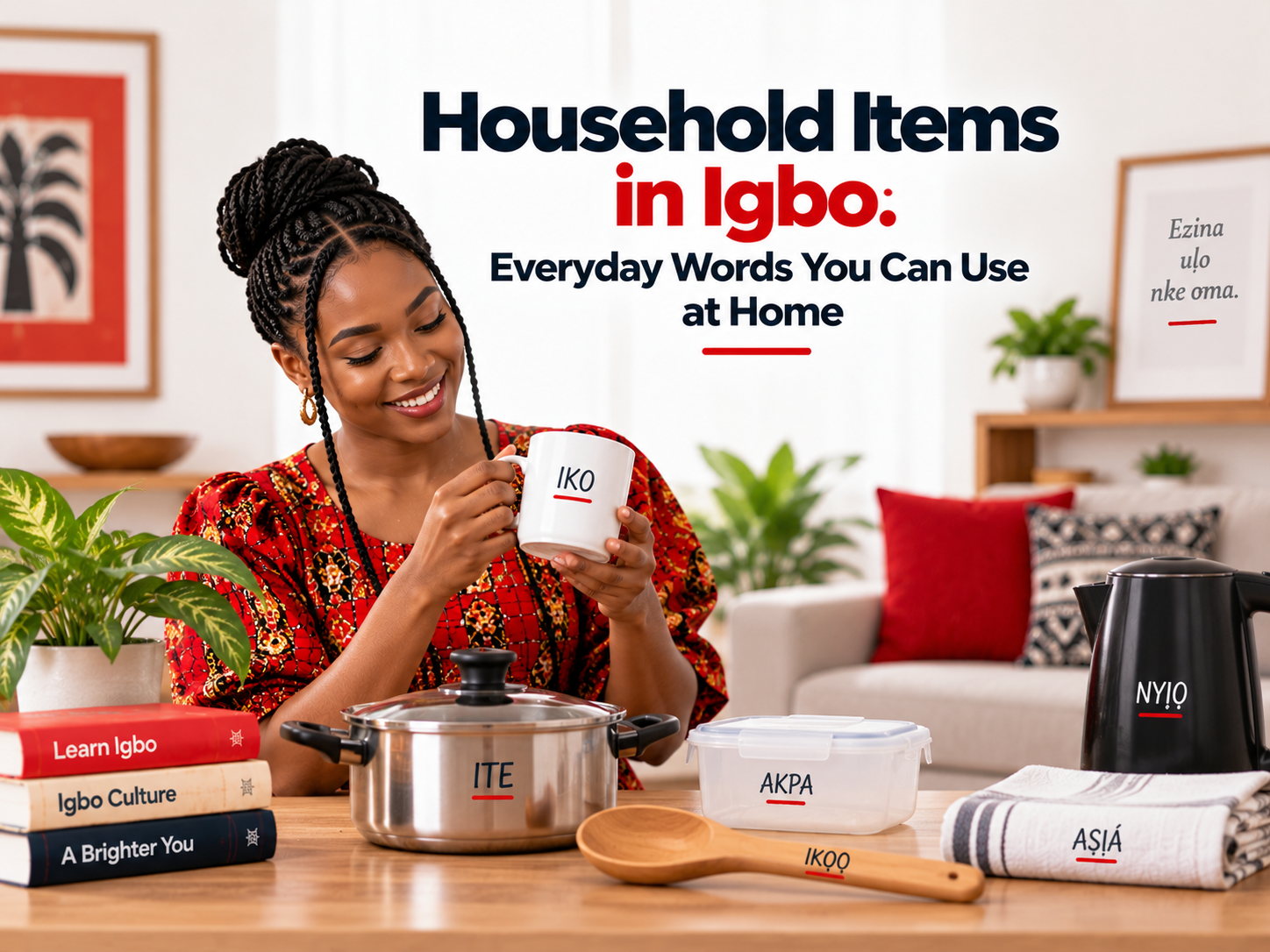
Look around your house.
There’s probably a chair nearby. Maybe a table. In the kitchen, you’ll find plates, pots and spoons. In your room, there’s a bed, clothes and shoes.
You already use these things every day. So why not start learning their names in Igbo?
In this guide, you’ll learn some household items in Igbo and, more importantly, see how to use them in simple sentences.
You don’t need to memorise a long vocabulary list. Start with the things around you and practise as you use them.
Household Items in Igbo: Quick Guide
If you’re scanning, start here.
| English | Igbo | Try it in a sentence |
|---|---|---|
| Chair | Òchè | Nọdụ n’òchè. — Sit on the chair. |
| Television | Ígwé Onyònyó | Gbanye Ígwé Onyònyó. — Turn on the television. |
| Table | Ndòkwàsà | Dèbè ya n’èlú Ndòkwàsà. — Keep it on the table. |
| Pot | Ìtè | Tinye mmírí n’ìtè. — Put water in the pot. |
| Plate | Èfèrè | Weta èfèrè abụọ. — Bring two plates. |
| Spoon | Ngájí | Nyé m ngájí. — Give me a spoon. |
| Bed | Àkwà | Dína n’àkwà. — Lie on the bed. |
| Shoe | Àkpùkpòụkwụ | Àkpùkpòụkwụ m dị ojii. — My shoe is black. |
Here’s the main thing to take from this:
Don’t just learn the name of the object. Learn something you can say with it.
This topic is part of IgboLearn’s Introduction to Igbo Conversations lesson, where the tutor teaches more everyday vocabulary and shows you how to use it.

👉 Continue the Introduction to Igbo Conversations lesson on IgboLearn
Start With the Things in Your Living Room
You don’t have to search very far for Igbo words to practise.
Start in your living room.
Chair in Igbo
Òchè — Chair
Now use it:
Nọdụ n’òchè. — Sit on the chair.
That’s immediately more useful than remembering òchè on its own.
You’re learning the object and seeing how it appears when you’re actually speaking to someone.
Television in Igbo
Ígwé Onyònyó — Television
You can say:
Gbanye Ígwé Onyònyó. — Turn on the television.
That’s something you could actually need at home.
And that’s the approach we’re going to keep using.
Word → meaning → something useful you can say.
Igbo Words for Things in the Kitchen
Now walk into your kitchen.
You’ll find plenty of everyday objects you can start naming in Igbo.
Pot in Igbo
Ìtè — Pot
Instead of stopping there, practise:
Tinye mmírí n’ìtè. — Put water in the pot.
Plate in Igbo
Èfèrè — Plate
Try:
Weta èfèrè abụọ. — Bring two plates.
Spoon in Igbo
Ngájí — Spoon
And one you could easily use at the table:
Nyé m ngájí. — Give me a spoon.
Notice what you’re doing.
You’re not memorising three disconnected words.
You’re learning how to ask someone to do something using the objects around you.
If you want more vocabulary you can use around meals, you can also read our guide to Igbo foods and drinks.
Learn Igbo With Things You See Every Day
Your bedroom gives you another easy place to practise.
For example:
Àkwà — Bed
You can use it in:
Dína n’àkwà. — Lie on the bed.
Then there’s:
Àkpùkpòụkwụ — Shoe
And you can say:
Àkpùkpòụkwụ m dị ojii. — My shoe is black.
This is why household vocabulary is so useful when you’re starting out.
You don’t need flashcards in front of you every time you practise.
Your house can become the practice material.
See the chair? Try to remember òchè.
Pick up a spoon? Think ngájí.
Walk past your bed? Say àkwà.
You’re connecting the Igbo word to the actual object rather than only connecting it to another English word.
Try This Around Your House
Here’s a simple challenge.
Look around and find:
one chair
one plate
one spoon
one bed
one pair of shoes
Before looking back at this post, try naming each one in Igbo.
Then go one step further.
Choose one of those objects and remember the sentence you learnt with it.
For example:
Ngájí — Spoon
becomes:
Nyé m ngájí. — Give me a spoon.
That’s the progression you want:
recognise → remember → use.
Don’t Stop at Naming Things
Knowing that èfèrè means plate is useful.
Being able to say:
Weta èfèrè abụọ. — Bring two plates.
is even more useful.
That’s because your goal isn’t simply to build a mental dictionary of Igbo words.
You want those words to eventually become part of what you can say and understand in a conversation.
If you’re still learning how everyday exchanges work, read How to Have a Simple Conversation in Igbo.
You can also practise basic Igbo greetings so you can start a conversation before moving into other everyday topics.
Learn More Everyday Igbo Vocabulary
We’ve deliberately kept this guide practical rather than giving you every household word from the lesson.
Start with the objects you see most often.
Learn their names.
Use them in short sentences.
Then add more.
In the full Introduction to Igbo Conversations lesson, the tutor takes you through the household vocabulary and examples so you can hear and practise them as part of your wider Igbo learning.
👉 Continue the Introduction to Igbo Conversations lesson on IgboLearn
You can also browse all Igbo lessons on IgboLearn when you’re ready for another topic.
For now, look around your house.
Can you name five things you see in Igbo without checking the table?