
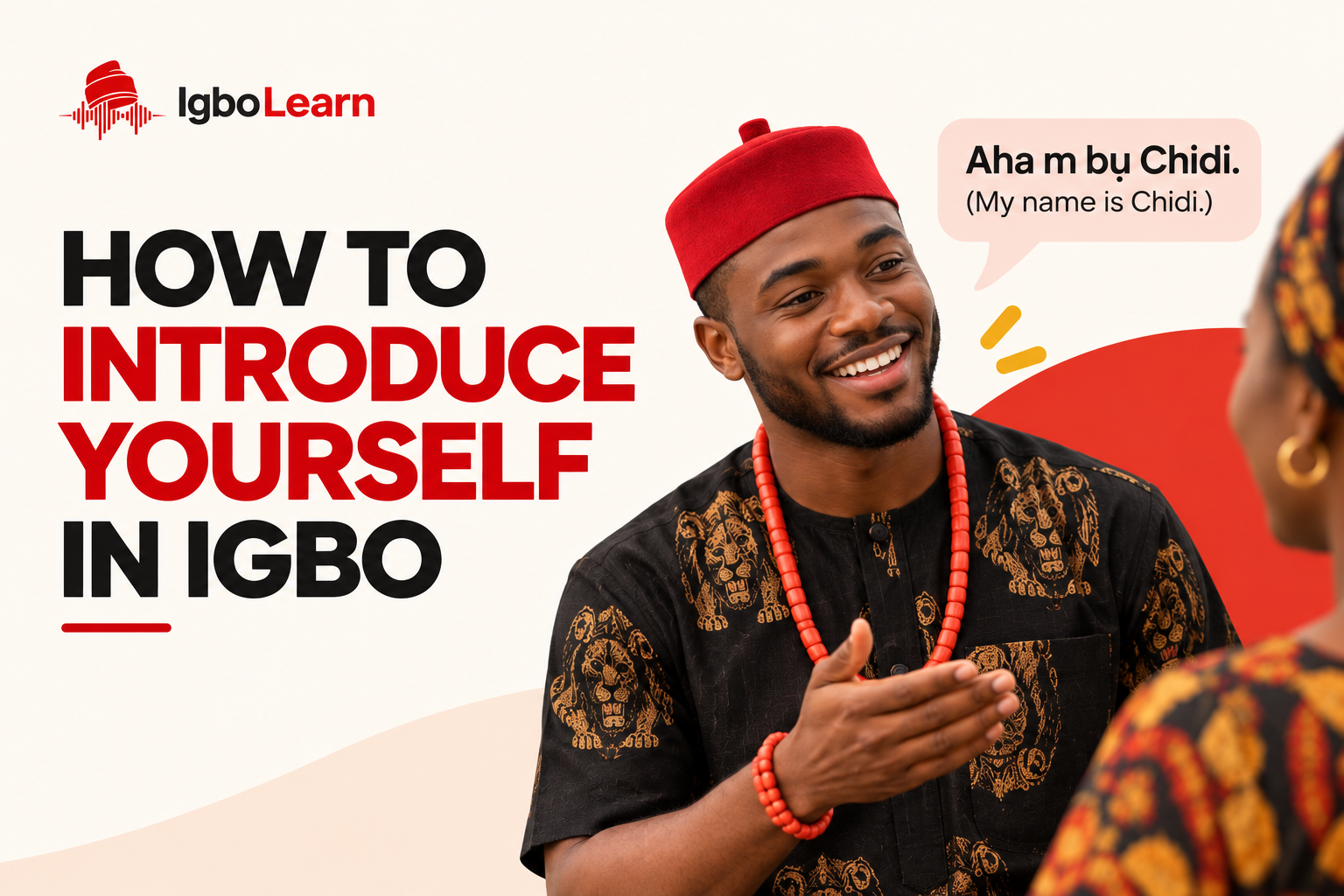
If you want to introduce yourself in Igbo, you can start with:
Aha m bụ…
My name is…
For example:
Aha m bụ Ada.
My name is Ada.
But your name is only the beginning. You may also want to tell someone where you’re from, where you live, your age, or something simple about yourself.
In this guide, you’ll learn the basic Igbo phrases you need to put together a simple self-introduction in Igbo (Nkowa Onwe).
How to Introduce Yourself in Igbo: Quick Answer
If you just need the phrases, start here:
| English | Igbo |
|---|---|
| My name is Ada | Aha m bụ Ada. |
| I come from Imo State | E si m mpaghara Imo. |
| I live in America | E bi m na America. |
| I am 20 years old | A dị m afọ iri abụọ. |
| I am a woman | A bụ m nwanyị. |
| I am a man | A bụ m nwoke. |
| I am beautiful/handsome | A mara m mma. |
Now, let’s break them down so you can use them to talk about yourself, rather than simply memorising Ada’s introduction.
How Do You Say “My Name Is” in Igbo?
To say “My name is…” in Igbo, use:
Aha m bụ…
For example:
Aha m bụ Ada.
My name is Ada.
Just replace Ada with your own name.
Aha m bụ Chidi.
My name is Chidi.
Aha m bụ Amaka.
My name is Amaka.
So if someone asks your name, one phrase you want to remember is:
Aha m bụ [your name].
Simple.
If you want to hear how aha, bụ or other Igbo words are pronounced, search for them on the IgboLearn Dictionary, listen to the pronunciation and practise saying them yourself.
How Do You Say “I Am From…” in Igbo?
After telling someone your name, you may want to tell them where you’re from.
In the free Igbo Lesson – Basic Greeting and Introductions – the tutor uses Imo State as an example:
E si m Imo Steeti.
I come from Imo State.
The lesson also teaches:
E si m mpaghara Imo.
I come from Imo State.
Here, mpaghara is used for state.
The important structure to remember is:
E si m…
I come from…
You can then use the structure with where you come from.
So when you’re practising your own Igbo self-introduction, don’t just memorise Imo. Replace it with your own location.
How Do You Say “I Live In…” in Igbo?
Where you come from and where you live are not always the same place.
To say “I live in…” in Igbo, the lesson teaches:
E bi m…
For example:
E bi m na America.
I live in America.
The tutor explains bi as live in ” in this context.
This means you can now introduce yourself with your name, where you’re from and where you live:
Aha m bụ Ada.
My name is Ada.
E si m mpaghara Imo.
I come from Imo State.
E bi m America.
I live in America.
Three simple sentences and you already have the beginning of a proper introduction.
How Do You Say Your Age in Igbo?
Another thing you may want to include when introducing yourself is your age.
The structure taught in the lesson is:
A dị m afọ…
For example:
A dị m afọ iri abụọ.
I am 20 years old.
The tutor explains that afọ means year.
So you can change the number at the end to match your age.
For example:
A dị m afọ iri.
I am 10 years old.
A dị m afọ iri abụọ.
I am 20 years old.
A dị m afọ iri atọ.
I am 30 years old.
This is also where learning numbers in Igbo becomes useful. Once you can say your age in Igbo, you can use it to complete this sentence.
How Do You Say “I Am a Woman” in Igbo?
To say “I am a woman” in Igbo, say:
A bụ m nwanyị.
And to say “I am a man” in Igbo, say:
A bụ m nwoke.
So:
A bụ m nwanyị.
I am a woman.
A bụ m nwoke.
I am a man.
Notice the structure:
A bụ m…
I am…
As you continue learning Igbo, you’ll come across this structure in other sentences too.
How Do You Say “I Am Beautiful” in Igbo?
Now, you may not necessarily need this every time you introduce yourself, but you should know how to say it.
A mara m mma.
In the lesson, this is used for:
I am beautiful.
The tutor also explains that it can be used for someone who is handsome.
So:
A mara m mma.
I am beautiful / I am handsome.
Feel free to add that one to your introduction with confidence.
A Full Self-Introduction in Igbo
Now let’s put the phrases together.
Imagine Ada is from Imo State, lives in America and is 20 years old.
Her introduction could be:
Aha m bụ Ada.
My name is Ada.
E si m mpaghara Imo.
I come from Imo State.
E bi m America.
I live in America.
A dị m afọ iri abụọ.
I am 20 years old.
A bụ m nwanyị.
I am a woman.
A mara m mma.
I am beautiful.
And that’s it.
You have a simple Igbo self-introduction.
You also don’t need to say every sentence whenever you meet someone. Pick the information that makes sense for the conversation you’re having.
Practise Introducing Yourself in Igbo
Now, don’t use Ada.
Use yourself.
Start with:
Aha m bụ ______.
Then:
E si m ______.
E bi m ______.
A dị m afọ ______.
A bụ m ______.
Try saying the entire introduction without looking at the English translations.
This is where you move from knowing Igbo phrases to actually being able to speak Igbo.
Don’t reading it in your head. Say it aloud.
The goal is that when you meet someone and want to introduce yourself in Igbo, you don’t need to first construct the entire sentence in English and translate it.
You already know what to say.
Learn How to Introduce Yourself in Igbo for Free

Want to hear how these phrases are actually pronounced?
Take the Nkọwa Onwe (Self-Introduction) topic from IgboLearn’s free Basic Greetings and Introductions Igbo lesson.
You can watch the free lesson sample, listen to an Igbo tutor pronounce the phrases, and practise introducing yourself along with the lesson.
Take the Free Igbo Lesson Now →
You can also use the IgboLearn Dictionary to look up individual Igbo words, listen to their pronunciation, and practise saying them.
Ready to keep learning?
Download the IgboLearn app and practise speaking, listening and learning Igbo every day.
Read also: 4 Best Apps to Learn Igbo in 2026