
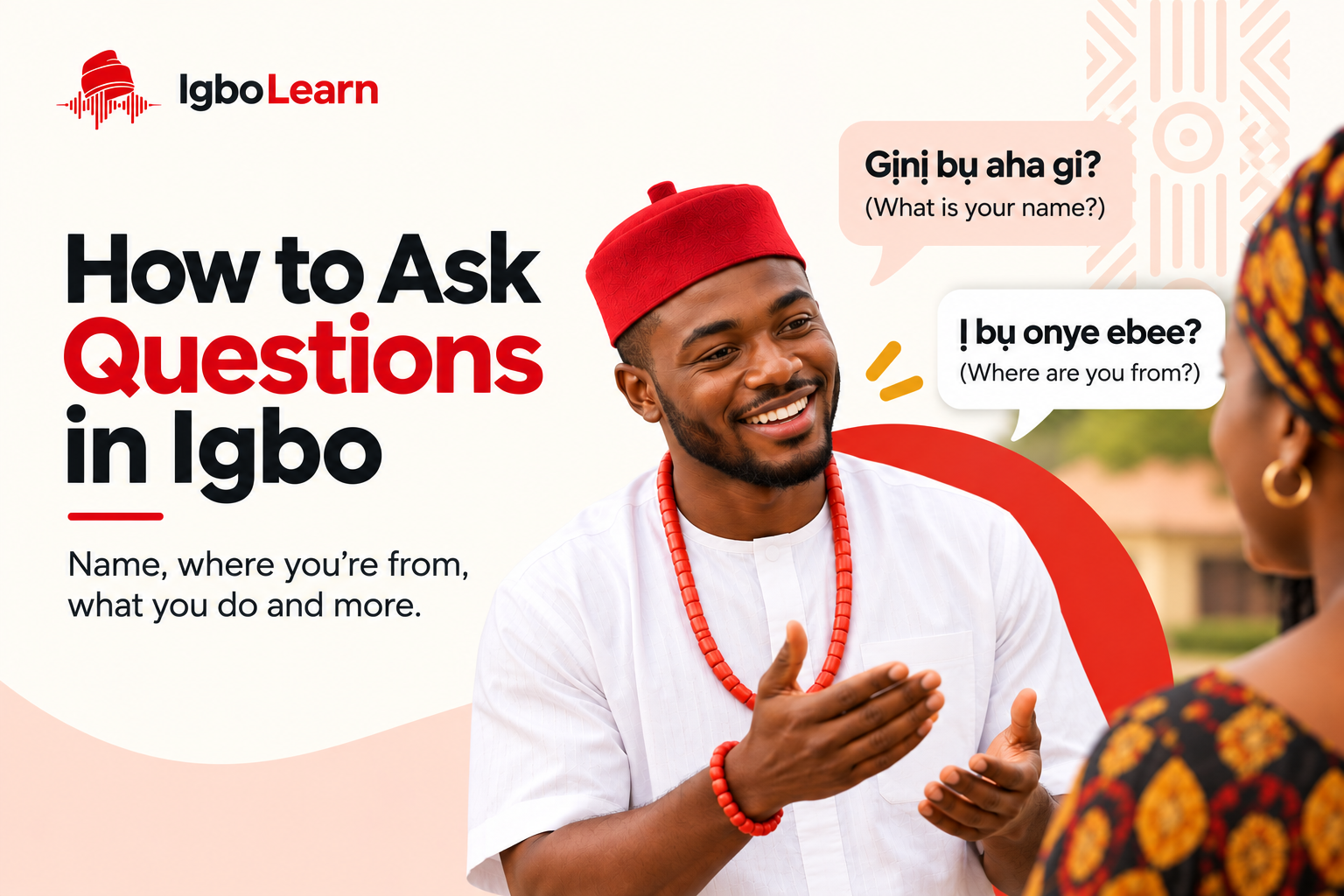
Once you know how to introduce yourself in Igbo,the next step is learning how to ask questions in Igbo and understand the questions people ask you.
What is your name? Where are you from? What do you do? How about you?
These are simple questions, but they are what turn the Igbo phrases you have learnt into an actual conversation.
In this guide, you’ll learn some common questions in Igbo, what they mean and how you can respond to them.
Common Questions in Igbo: Quick Answer
If you just want the phrases, start here:
| English | Igbo |
|---|---|
| What is your name? | Gịnị bụ aha gị? |
| Where are you from? | Ị bụ onye ebee? |
| How about you? | Kedu maka gị? |
| What do you do? | Gịnị ka ị na-arụ? |
| What is the name of your school? | Kedu aha ụlọ akwụkwọ gị? |
| What class are you in? | Kedu klaasị ị nọ? |
These questions appear in a simple conversation between Emeka and Adaeze in the lesson.
Now, let’s look at what each question means and how you can answer it.
How Do You Say “What Is Your Name?” in Igbo?
To ask “What is your name?” in Igbo, say:
Gịnị bụ aha gị?
You can respond:
Aha m bụ…
My name is…
For example:
Gịnị bụ aha gị?
What is your name?
Aha m bụ Adaeze.
My name is Adaeze.
This connects directly to what we learnt about introducing yourself. You already know how to tell someone your name in Igbo. Now you know how to ask for theirs.
In the free IgboLearn Basic Greetings and Introductions lesson, the tutor puts both sides together in a conversation:
Aha m bụ Emeka. Gịnị bụ aha gị?
My name is Emeka. What is your name?
Aha m bụ Adaeze.
My name is Adaeze.
This is the part worth practising as a complete exchange rather than memorising only one sentence.
How Do You Say “Where Are You From?” in Igbo?
To ask someone “Where are you from?” in Igbo, the lesson uses:
Ị bụ onye ebee?
The response can be:
Abụ m onye Enugu Steeti.
I am from Enugu State.
In the lesson, Adaeze then says:
Abụ m onye Anambra Steeti.
I am from Anambra State.
The location changes depending on where you are from.
So don’t memorise Enugu State or Anambra State. Practise the sentence using your own state, town or community.
How Do You Say “How About You?” in Igbo?
This is a very useful one for keeping a conversation going.
Kedu maka gị?
means:
How about you?
Look at how naturally it works in the conversation:
Ị bụ onye ebee?
Where are you from?
Abụ m onye Enugu Steeti. Kedu maka gị?
I am from Enugu State. How about you?
Instead of answering a question and stopping there, Kedu maka gị? passes the question back to the other person.
That one phrase can make your Igbo conversations feel much more natural.
Read: How to Say Good Morning in Igbo
How Do You Ask “What Do You Do?” in Igbo?
To ask “What do you do?” in Igbo, say:
Gịnị ka ị na-arụ?
In the lesson, Adaeze responds:
Abụ m nwata akwụkwọ.
I am a student.
So the exchange is:
Gịnị ka ị na-arụ?
What do you do?
Abụ m nwata akwụkwọ.
I am a student.
The response you give will, of course, depend on what you do.
How Do You Ask Someone About Their School in Igbo?
The conversation goes a little further by asking about school.
To ask “What is the name of your school?”, say:
Kedu aha ụlọ akwụkwọ gị?
Adaeze responds:
Aha ụlọ akwụkwọ m bụ Queen’s College, Lagos.
The name of my school is Queen’s College, Lagos.
Notice how similar the question and answer are:
Kedu aha ụlọ akwụkwọ gị?
What is the name of your school?
Aha ụlọ akwụkwọ m bụ…
The name of my school is…
Once you start noticing these patterns, you don’t have to treat every Igbo sentence as something completely new.
How Do You Ask “What Class Are You In?” in Igbo?
To ask “What class are you in?”, the lesson teaches:
Kedu klaasị ị nọ?
The response in the conversation is:
Anọ m na klaasị nke ise.
I am in class five.
Again, you can replace the class with the one that applies to you.
A Simple Conversation in Igbo
Now let’s put everything together.
The lesson shows Emeka and Adaeze meeting and having a simple conversation. It starts with a greeting and asking how the other person is before moving into names, where they come from and school.
A shorter version you can practise is:
Emeka: Ndeewo.
Hello.
Adaeze: Oo, ndeewo.
Yes, hello.
Emeka: Kedu ka ị mere?
How are you?
Adaeze: Adị m mma, daalụ.
I am fine, thank you.
Emeka: Aha m bụ Emeka. Gịnị bụ aha gị?
My name is Emeka. What is your name?
Adaeze: Aha m bụ Adaeze. Emeka, ị bụ onye ebee?
My name is Adaeze. Emeka, where are you from?
Emeka: Abụ m onye Enugu Steeti. Kedu maka gị?
I am from Enugu State. How about you?
Adaeze: Abụ m onye Anambra Steeti.
I am from Anambra State.
Emeka: Gịnị ka ị na-arụ?
What do you do?
Adaeze: Abụ m nwata akwụkwọ.
I am a student.
This is where the things you’ve been learning start coming together.
You’re no longer learning Ndeewo, Kedu ka ị mere?, Aha m bụ… and Gịnị bụ aha gị? as separate phrases.
You’re having a conversation.
Practise Asking These Questions in Igbo
Don’t only practise the answers.
Ask the questions too.
Find someone and ask:
Gịnị bụ aha gị?
Then:
Ị bụ onye ebee?
And:
Gịnị ka ị na-arụ?
If they ask you the same question, answer in Igbo and use:
Kedu maka gị?
to send the conversation back to them.
The tutor ends the lesson with a simple challenge:
Gịnị bụ aha gị?
Can you answer without looking back at the translation?
Learn More Questions in Igbo for Free

The best way to get comfortable with these questions in Igbo is to actually use them in conversation.
Want to hear these questions and responses instead of only reading them?
You can take the free Basic Greetings and Introductions lesson on IgboLearn and hear an Igbo tutor use these phrases in a real conversation.
Take the Free Igbo Lesson Now →
You can also use the IgboLearn Dictionary to search for individual Igbo words, listen to their pronunciation, and practise saying them aloud.
Ready to keep learning?
Download the IgboLearn app and practise listening, speaking and having everyday conversations in Igbo.
Read: 4 Best Apps to Learn Igbo in 2026