
Nwanne, Nnoo!
You being here means learning Igbo is important, and you’re looking for one of the best apps to learn Igbo. I can relate. It is important to me as well.
As an Igbo girl from Imo State who grew up understanding Igbo but speaking it only in my head, I wanted to learn how to actually speak Igbo.
My reasons are different.
For example, I want to get things cheaper in the market, teach my children my language, gist with my mum, dad, and uncles in Igbo, and, most importantly, have secret conversations with my husband in Igbo.
This last one is very important to me because I believe Igbo is a love language.
This desire led me to download 14 different Igbo language learning apps to find the best apps to learn Igbo online.
In my search for the best Igbo learning app, I noticed one key thing: apps built with one to three African languages in mind were generally more detailed and helpful than apps trying to teach over 100 languages.
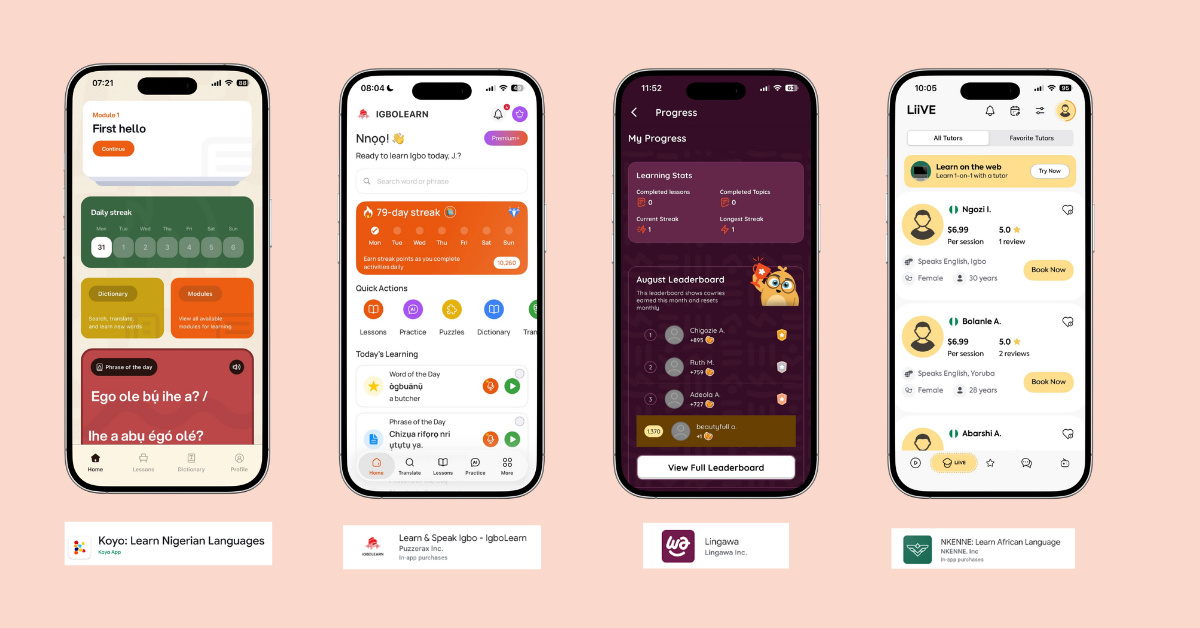
So, if you’re looking for an app to learn Igbo, improve your Igbo pronunciation, take Igbo lessons online, or simply speak more Igbo, these are the four apps I think are worth looking at.
The 4 Best Apps to Learn Igbo at a Glance
If you don’t want to read the full review yet, here’s my quick summary:
- IgboLearn
Best if you want an all-round Igbo learning experience with lessons, speaking and pronunciation practice, vocabulary, translation, a dictionary, games and cultural learning. - KOYO
Best if you want short, simple Igbo lessons, vocabulary and audio pronunciation without paying for a subscription. - Lingawa
Best if you want private online Igbo lessons with a tutor, alongside exercises for vocabulary, dialogue and sentence building. - NKENNE
Best if you prefer learning through audio lessons and want access to African cultural content, community features and Igbo tutors.
Quick Answer: What Is the Best App to Learn Igbo?
My best overall is IgboLearn.
It gives the most complete mix of speaking, listening, lessons, practice, and cultural learning in one place. You get speaking and pronunciation practice, tutor-led lessons, vocabulary, a dictionary, translations, conversations, puzzles, and cultural content in one app.
However, the best Igbo app for you depends on how you prefer to learn.
1. IgboLearn: Best Overall App to Learn Igbo
This is my number one.
I have a 79-day streak. It is that serious.
IgboLearn stands out because it is built specifically for the Igbo language. It is also very practical in a way that is not annoying.
You will practise speaking a LOT on this app.
As you open IgboLearn, you are met with three things to learn every single day: the Igbo Word of the Day, Phrase of the Day, and Proverb of the Day.
Each of the day’s tasks comes with audio and a practice feature. You play the audio to listen to what is said, practise immediately, and get scored.
IgboLearn prioritises audio, and this is amazing because Igbo is a tonal language. You need to hear how words are pronounced and understand how pronunciation and context can change meaning.
The audio practice with the score is very useful because, as you know, practice makes perfect. The more you say a word, the more it sticks. The more you hear it, the better you can repeat it.
The best part is that you can practise speaking Igbo in the comfort of your home without being shy or ashamed.
Just you and your desire to learn.

Igbo Lessons
IgboLearn also has structured Igbo lessons taught by real Igbo tutors.
The lessons usually contain 6–10 topics that are around three to five minutes long. The best part is that there is an assessment immediately afterwards.
This helps you recall and practise what you have just learnt instead of watching a lesson and immediately forgetting everything.
Some of the Igbo lessons available include:
- How to Build Igbo Sentences Parts 1 & 2
- Basic Greetings and Introductions
- Stages of Marriage in Igbo Culture
- Introduction to Igbo Verbs
- Igbo Numbers and Alphabets
The lessons also go beyond simply learning how to speak Igbo and into understanding Igbo culture.
For example, the lesson Stages of Marriage in Igbo Culture does a good job of explaining how traditional Igbo marriages work, the rites involved, and why they are performed.

Igbo Translator and Dictionary
IgboLearn also has an Igbo translator and Igbo dictionary.
The translator supports multiple languages to Igbo, not just English. You can translate Yoruba to Igbo, Chinese to Igbo, and much more.
Each translated word or sentence comes with audio pronunciation. You can listen to what has been translated and practise saying it immediately.
The IgboLearn dictionary also contains Igbo words and sentences with audio and pronunciation practice. You can search for words in English or Igbo.
This is useful when you don’t necessarily want to take a full lesson but just want to find an Igbo word, understand what something means, or learn how to pronounce it. Try it here

Igbo Puzzles and Games
IgboLearn has 10 different puzzles plus a flashcard section.
You get to match words, complete sentences, answer questions, and practise what you have learnt in different ways.
The games also include audio attached to the options.
IgboLearn is not playing. You must hear Igbo and speak Igbo.
This is why I prefer people who build apps around a singular language. It shows intention.

Guided Igbo Conversations
IgboLearn also has Guided Conversations where you can practise different everyday scenarios.
Some examples include:
- Greeting by Time
- Meeting Someone New
- Asking for Directions
- At the Market
The conversations let you practise the type of Igbo you would actually need in real life rather than learning random vocabulary without knowing what to do with it.

Has IgboLearn Actually Helped Me Improve My Igbo?
Yes. Absolutely.
I infuse Igbo more into my sentences. I notice that I now pray and think in Igbo. I also write Igbo better now.
I know more Igbo proverbs too, which has taught me more about Igbo culture.
That is ultimately what I want from an Igbo learning app. I don’t just want to know random words. I want Igbo to become a language I actually use.
IgboLearn Pricing
IgboLearn has both free and paid plans.
The free plan gives you access to basic learning features as well as the Igbo dictionary.
Premium unlocks more of the app’s learning features.
At the time of writing, IgboLearn Premium costs ₦4,900 in Nigeria and $5 USD in international markets, making it one of the more affordable options on this list.
If you want to see how IgboLearn works before getting started, you can also watch the videos in the IgboLearn Features playlist on YouTube to see the different features in action.
2. KOYO: Best Free Igbo App for Short Lessons
KOYO is a simple yet detailed Nigerian language learning app that teaches Igbo alongside languages such as Yoruba and Edo.
Its lessons are designed to be short, making KOYO an interesting option if you’re looking for short Igbo lessons you can fit into a busy schedule.
The app also has a Phrase of the Day feature with Igbo audio pronunciation.
For learning Igbo, KOYO has two key features I found particularly useful: Lessons and Dictionary.

KOYO Igbo Lessons
KOYO’s Igbo lessons are more interactive, with a question-and-answer style.
The lessons I tried had modules covering things like:
- First Hello
- How Are You?
- My Name Is…
- Where Are You From?
- Yes, No, Please and Thank You
You see an Igbo sentence, play the audio, and answer questions around that sentence multiple times until it sticks.
You can only move to a new module when you have successfully completed the previous one.
KOYO’s lessons focus heavily on listening and understanding what you hear.
If your main goal is to understand spoken Igbo and gradually build basic vocabulary, KOYO works well.
KOYO Igbo Dictionary
KOYO also has an Igbo dictionary with words and their audio pronunciations attached.
When you open a word, you see the Igbo word, its meaning, and sentence examples. The sentence examples also have audio so you can listen to how they are pronounced.
One thing I particularly like is the attention to dialect differences.
For some words, you can hear multiple ways of saying the same thing, which is useful because anyone learning Igbo eventually discovers that the Igbo you hear can vary depending on where someone is from.

Is KOYO Free?
Yes. At the time of my review, KOYO is free to use.
That makes it a good option if you’re looking for a free app to learn Igbo and want something simple that you can use for short daily practice.
3. Lingawa: Best for Learning Igbo With a Live Tutor
Lingawa takes a different approach to learning Igbo.
Rather than being primarily a self-learning Igbo app, Lingawa is built around connecting learners with native-speaking Igbo tutors for live online Igbo lessons.
If you want private Igbo lessons with an Igbo tutor online, Lingawa is probably the strongest option on this list.
You get to listen to the tutor, view their profile, and see how other students have rated them. This makes choosing an Igbo teacher much easier.
Lingawa also lets you schedule lessons around your availability.
During registration, you select a time that works for you and can find tutors available around that schedule.
I like this because it stops you from choosing a tutor only to discover that your schedules don’t work together.
Once you have selected your tutor and plan, you can schedule your Igbo classes.

Lingawa Igbo Practice
Lingawa doesn’t just give you an Igbo tutor. There are also tools to help you practise between lessons.
The practice side is quite extensive. Different scenarios can include exercises such as:
- Vocabulary Drills
- Dialogue
- Sentence Builder
- Matching Games
Vocabulary Drills
This works like flashcards with audio.
You see an Igbo word, play the audio, and flip the card to see the English translation. When you are sure you have learnt that word, you move to the next card.
Dialogue Practice
Lingawa sets up a scenario with two people having a conversation.
You become one of the characters.
For example, the app might take Emeka’s role while you take Ola’s.
You then listen and practise your side of the Igbo conversation.
There is also a recording option where you can record yourself saying what you have heard and compare your recording with the pronunciation audio provided.
I like this because Lingawa’s dialogue exercises prepare you for real conversations.
If someone says Ndeewo, for example, you don’t just recognise the word. You have practised responding within an actual conversation.
Sentence Builder
Here, Lingawa makes you translate what you see on the screen from English to Igbo and vice versa.
You select the words, see your result, and try again until you get it right.
Matching Games
Lingawa gives you different Igbo words and phrases alongside their English translations.
You match the Igbo to the correct English meaning.

Why Lingawa Works
For me, the biggest advantage is convenience.
If you want to learn Igbo with a tutor, you don’t have to go searching everywhere for someone, wondering whether they can teach or trying to organise payment separately.
Lingawa has already brought the tutors and learning system together.
It is especially useful for someone who knows they learn better when another human being is actually teaching them, correcting them, and holding them accountable.

How Much Does Lingawa Cost?
Lingawa is the most expensive option on this list because you’re paying for live tutoring rather than just access to an app.
At the time of writing, individual Igbo lessons start from $18 per session on the weekly plan, while monthly and course bundles reduce the per-session price.
So, if you’re searching for an affordable self-paced Igbo learning app, Lingawa probably isn’t the first option I would choose.
But if your priority is learning Igbo online with a real tutor, the price makes more sense because you’re paying for personalised teaching.
4. NKENNE: Best for Audio-Based Igbo Learning
NKENNE is an African language-learning app that includes Igbo, along with several other African languages.
Its approach is particularly interesting for people who like audio-based language learning.
On NKENNE, a lot of the learning experience is built around listening.
You listen to Igbo lessons and conversations in a listen-and-repeat style.
For example, the audio might say: “Listen and repeat: Ke ka unu dị?”
You are expected to repeat and speak as you go.
This makes NKENNE interesting if you prefer to learn Igbo while commuting, walking, or doing something else rather than sitting down and staring at your phone.

Learning Igbo With NKENNE
NKENNE combines language lessons with cultural content and community.
Beyond Igbo language lessons, you can find podcasts, cultural content and community features.
This means it feels less like you’re simply memorising Igbo vocabulary and more like you’re entering a broader African language and culture platform.
NKENNE Igbo Tutors
NKENNE also offers one-on-one tutoring through NKENNE LiiVE.
You can choose Igbo as your language and book sessions with a tutor for personalised guidance.
This gives NKENNE an interesting middle ground: you can use the app for self-paced audio learning and then book a real tutor when you want more direct help.

Is NKENNE Free?
NKENNE has a free plan.
The free tier currently includes a limited amount of Igbo lesson content alongside access to cultural blogs, podcasts, and its community.
There is also NKENNE Premium, which unlocks its larger lesson library, plus separate one-on-one tutoring through NKENNE LiiVE.
If you like learning languages primarily through listening, NKENNE is one of the stronger options I tried.
IgboLearn vs KOYO vs Lingawa vs NKENNE: Which Is the Best App to Learn Igbo?
After trying these apps, I don’t think there is one answer for everybody. It depends on how you want to learn Igbo.
If you want a free Igbo learning app for short, simple lessons, I would look at KOYO.
If you learn best by listening and want audio-based Igbo lessons you can take while doing other things, try NKENNE.
If what you really want is a real Igbo tutor who can teach and correct you one-on-one, choose Lingawa.
But if you want the best overall app to learn Igbo, my choice is IgboLearn.
It gives me the best balance of the things I actually need to learn and use the language: pronunciation practice, speaking, short lessons from Igbo tutors, assessments, vocabulary, translations, dictionary searches, conversations, games, and Igbo cultural content.
Most importantly, it gets me to actually speak Igbo instead of endlessly learning words.
For me, that is the point. I don’t just want to learn Igbo. I want to speak it.