
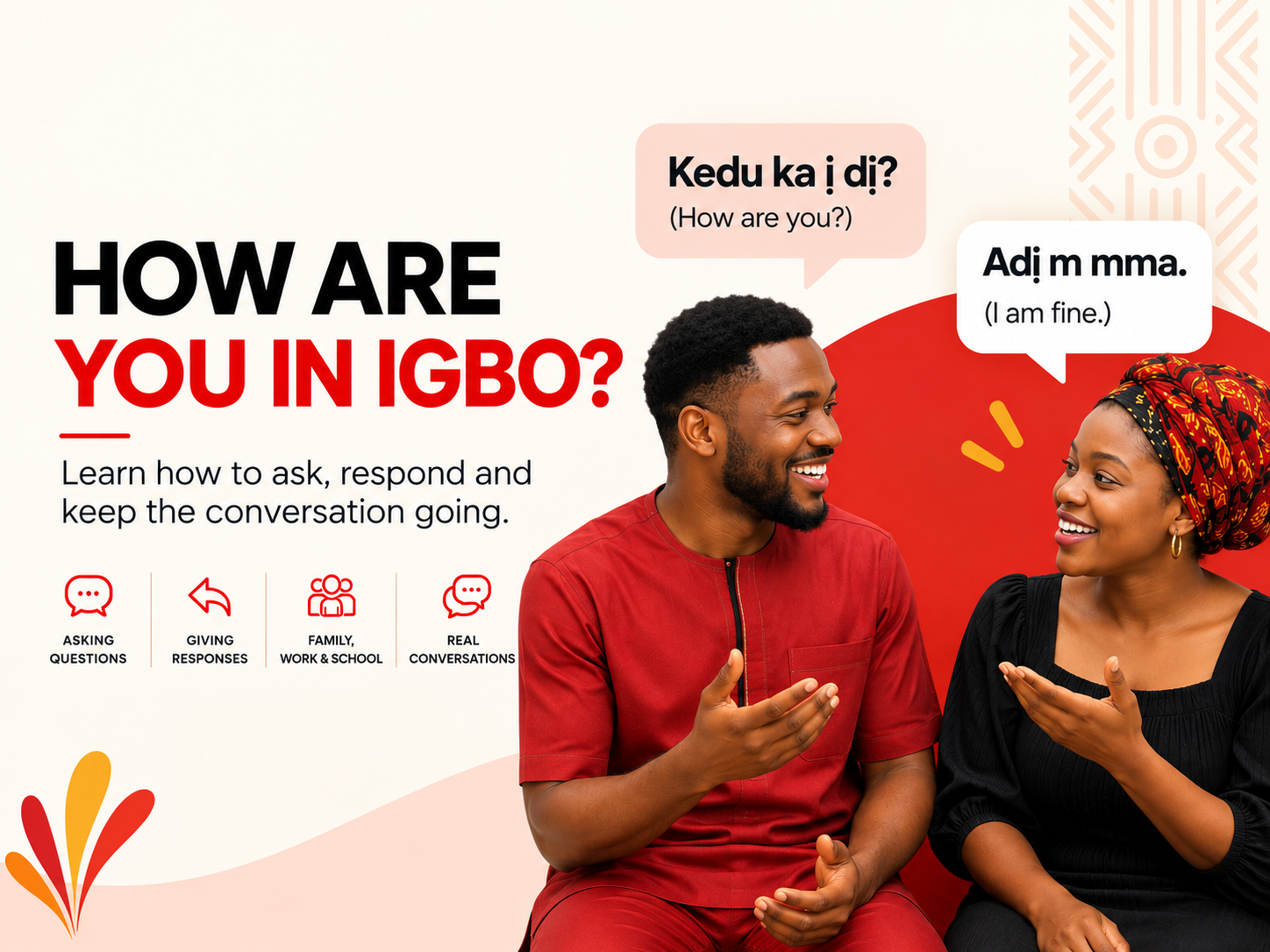
If you are learning Igbo, knowing how to greet someone is a good start. But what happens when they respond and the conversation continues?
Someone asks:
Kedu?
Or:
Kedu ka ị dị?
What do you say back?
There are different ways to ask “How are you?” in Igbo, and your response can change depending on exactly what you are being asked.
Let’s look at some of the common questions and the correct ways to respond.
What Does Kedu Mean in Igbo?
Kedu? is a common Igbo greeting.
In everyday conversation, you can think of it a little like saying:
How? or How far? or How now?
If someone says:
Kedu?
You can respond:
Ọ dị mma.
Ọ dị mma means “It is fine,” “It is okay,” or “It is good.”
So your conversation can be as simple as:
A: Kedu?
B: Ọ dị mma.
One thing to remember from this lesson is that the response to Kedu? is Ọ dị mma, not Adị m mma.
How Do You Say “How Are You?” in Igbo?
One way to ask “How are you?” in Igbo is:
Kedu ka ị dị? or Ke ka ị dị?
The response is:
Adị m mma.
This means:
I am fine.
So:
A: Kedu ka ị dị?
How are you?
B: Adị m mma.
I am fine.
This is one of those exchanges worth learning together. Don’t memorise only Kedu ka ị dị? Learn the response at the same time.
Kedu ka ị dị? → Adị m mma.
Want to hear how these words sound? Search for them using the IgboLearn Dictionary and listen to the pronunciation as you practise.
What Does “Kedu Ka Ị Mere?” Mean?
You may also hear: Kedu ka ị mere?
This means: How are you doing?
And you can respond: Adị m mma. (I am fine.)
So both of these questions can take the same response:
Kedu ka ị dị? → Adị m mma.
Kedu ka ị mere? → Adị m mma.
But remember the distinction the tutor makes in the lesson:
Kedu? → Ọ dị mma.
Kedu ka ị dị? → Adị m mma.
Kedu ka ị mere? → Adị m mma.
This is an important difference to practise if you want your Igbo to become more natural.
See also: How to Say Good Morning in Igbo
How to Ask “How Is the Family?” in Igbo
Once you know how to ask how someone is doing, you can take the conversation further.
To ask “How is the family?”, say:
Kedu maka ezinụlọ?
Ezinụlọ means family.
The response taught in the lesson is: Anyị dị mma.
This means: We are fine.
So:
A: Kedu maka ezinụlọ?
How is the family?
B: Anyị dị mma.
We are fine.
Notice that the response has changed again.
You’re no longer talking about only yourself, so instead of Adị m mma for I am fine, you are saying:
Anyị dị mma.
We are fine.
How to Ask “How Is Work?” in Igbo
To ask someone how work is going, say:
Kedu maka ọrụ?
Ọrụ means work.
You can respond:
Ọ dị mma.
It is fine.
You can also say:
Ọrụ dị mma.
Work is fine.
So:
A: Kedu maka ọrụ?
How is work?
B: Ọ dị mma.
It is fine.
This is a simple phrase you can start using in everyday conversations with other Igbo speakers.
How to Ask “How Is School?” in Igbo
You can use the same structure to ask about school or someone’s studies.
Kedu maka akwụkwọ gị?
In the context of this lesson, akwụkwọ refers to school or study.
You can respond:
Ọ dị mma.
It is fine.
So you might have:
A: Kedu maka akwụkwọ?
How is school?
B: Ọ dị mma.
It is fine.
Once you understand the pattern, you can see how Kedu maka… helps you move beyond a basic greeting and ask about other parts of someone’s life.
Common Igbo Questions and Responses
Here’s a quick summary you can come back to when practising:
| Igbo | English | Response |
|---|---|---|
| Kedu? | How? / How far? | Ọ dị mma. |
| Kedu ka ị dị? | How are you? | Adị m mma. |
| Kedu ka ị mere? | How are you doing? | Adị m mma. |
| Kedu maka ezinụlọ? | How is the family? | Anyị dị mma. |
| Kedu maka ọrụ? | How is work? | Ọ dị mma. / Ọrụ dị mma. |
| Kedu maka akwụkwọ? | How is school? | Ọ dị mma. |
Don’t try to learn these as isolated translations.
Practise them as question → response pairs.
Kedu? → Ọ dị mma.
Kedu ka ị dị? → Adị m mma.
Kedu maka ezinụlọ? → Anyị dị mma.
That way, when someone actually asks you one of these questions, you are learning what to say next instead of stopping to translate every word in your head.
Practise Saying “How Are You?” in Igbo

Reading Igbo is useful, but if your goal is to speak Igbo, you also need to hear these phrases and say them yourself.
Start with this free Igbo lesson titled Basic Greetings and Introductions on the IgboLearn app, where an Igbo tutor walks you through these questions and responses.
You can watch the lesson, listen to the pronunciation, and practise along with the tutor.
You can also search for individual Igbo words and phrases using the IgboLearn Dictionary to hear their pronunciation and practise them again.
Ready to learn more Igbo?
Download the IgboLearn app and practise speaking, listening and learning Igbo every day.