
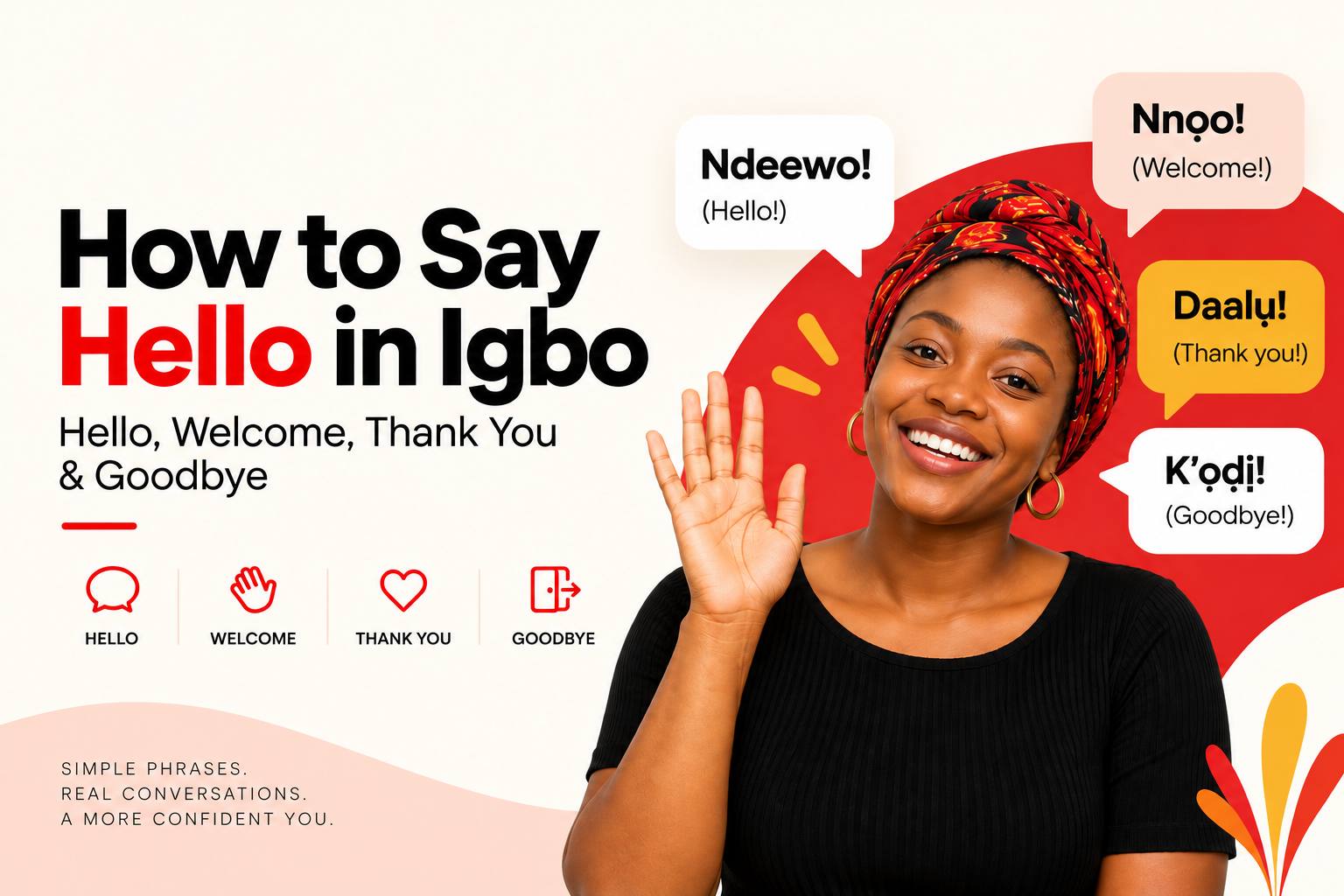
If you are learning Igbo, “How do you say hello in Igbo?” is probably one of the first questions you will have.
The simple answer is:
Ndeewo.
But hello isn’t the only basic Igbo greeting worth learning. How do you welcome someone? How do you say thank you? And what do you say when it is time to leave?
These are simple Igbo words and phrases, but they are also some of the ones you can start using immediately.
So, let’s learn how to say hello, welcome, thank you and goodbye in Igbo, including what changes when you are speaking to more than one person.
How Do You Say Hello in Igbo?
To say hello in Igbo, you can say:
Ndeewo.
You can use Ndeewo when greeting one person.
Ndeewo. → Hello / Hi.
You may see slightly different spellings of this greeting. In the IgboLearn lesson, the tutor explains that some people write it with two e’s, but Ndeewo is the form used throughout the lesson.
How to Say Hello to More Than One Person in Igbo
If you are greeting a group rather than one person, say:
Ndeewo nu.
This means:
Hello everyone. / Hi everyone.
So remember:
Ndeewo. → Hello to one person.
Ndeewo nu. → Hello to more than one person.
The nu is important because it changes who you are addressing.
Want to hear how Ndeewo is pronounced? Search for it in the IgboLearn Dictionary, listen to the pronunciation and practise saying it yourself.
How Do You Say Welcome in Igbo?
To say welcome in Igbo, say:
Nnọọ.
When welcoming one person:
Nnọọ. → Welcome.
For more than one person:
Nnọọ nu. → Welcome everyone.
You can see the same pattern we used with Ndeewo:
Ndeewo → Ndeewo nu
Nnọọ → Nnọọ nu
This is one of the useful things about learning phrases in context. Instead of memorising four unrelated expressions, you begin to notice how Igbo works.
How Do You Say Thank You in Igbo?
There are different ways to say thank you in Igbo.
Two taught in this lesson are:
Imeela.
and
Daalụ.
The tutor explains Imeela as meaning:
You have done well.
So when someone does something for you, you can say:
Imeela. → Thank you.
You can also simply say:
Daalụ. → Thank you.
For example, if someone gives you a gift, you could respond:
Daalụ.
or:
Imeela.
Both allow you to express your appreciation.
How to Say Thank You to a Group in Igbo
When thanking more than one person, the form you use depends on which expression you choose.
With Daalụ, say:
Daalụ nu. → Thank you all.
With Imeela, say:
Unu emeela.
The lesson explains Unu emeela as:
You all have done well.
So you have:
Daalụ → Thank you.
Daalụ nu → Thank you all.
And:
Imeela → Thank you / You have done well.
Unu emeela → Thank you all / You all have done well.
How Do You Say Goodbye in Igbo?
There are also different ways to say goodbye in Igbo.
One is:
Ka ọ dị.
In natural speech, the lesson shows how this becomes:
K’ọdị.
So you can say:
K’ọdị. → Goodbye.
Another expression you can use is:
Ka e mesịa.
This is also taught as a way to say goodbye.
So when it is time to leave, you have at least two phrases you can practise:
K’ọdị.
or:
Ka e mesịa.
Basic Igbo Greetings to Remember
If you are just starting to learn Igbo, you don’t need to memorise everything at once. Start with these:
| English | Igbo |
|---|---|
| Hello / Hi | Ndeewo |
| Hello everyone | Ndeewo nu |
| Welcome | Nnọọ |
| Welcome everyone | Nnọọ nu |
| Thank you | Daalụ |
| Thank you | Imeela |
| Thank you all | Daalụ nu |
| You all have done well / Thank you all | Unu emeela |
| Goodbye | K’ọdị |
| Goodbye | Ka e mesịa |
Practise saying them aloud rather than only reading them.
Better still, use them.
The next time you meet someone, try Ndeewo. When someone does something kind for you, say Daalụ or Imeela. When you are leaving, try K’ọdị or Ka e mesịa.
That is how these words start moving from things you have memorised to Igbo you can actually speak.
Why Learn Basic Igbo Greetings First?
If your goal is to learn to speak Igbo, greetings are a good place to begin because you don’t need a large vocabulary to use them.
You can learn one word today and actually say it to someone today.
Ndeewo.
That’s already Igbo.
Then you add Nnọọ. You add Daalụ. Then K’ọdị.
Little by little, you are building the vocabulary you need for real conversations.
As you learn more Igbo, you can move from individual greetings into introductions, questions, everyday conversations, and complete sentences.
Watch This Igbo Lesson for Free

Want to hear how these greetings actually sound?
Take the General Greetings topic in IgboLearn’s Basic Greetings and Introductions free Igbo lesson.
Watch the free sample and learn directly from an Igbo tutor.
You’ll hear how Ndeewo, Nnọọ, Daalụ, Imeela, K’ọdị and Ka e mesịa are pronounced and see how they are used.
You can also use the IgboLearn Dictionary to search for Igbo words, listen to their pronunciation and see how they are used.
Ready to learn more?
Download the IgboLearn app and practise speaking, listening and learning Igbo every day.
See also: 4 Best Apps to Learn Igbo in 2026: I Tried Them and Here’s My Honest Review