
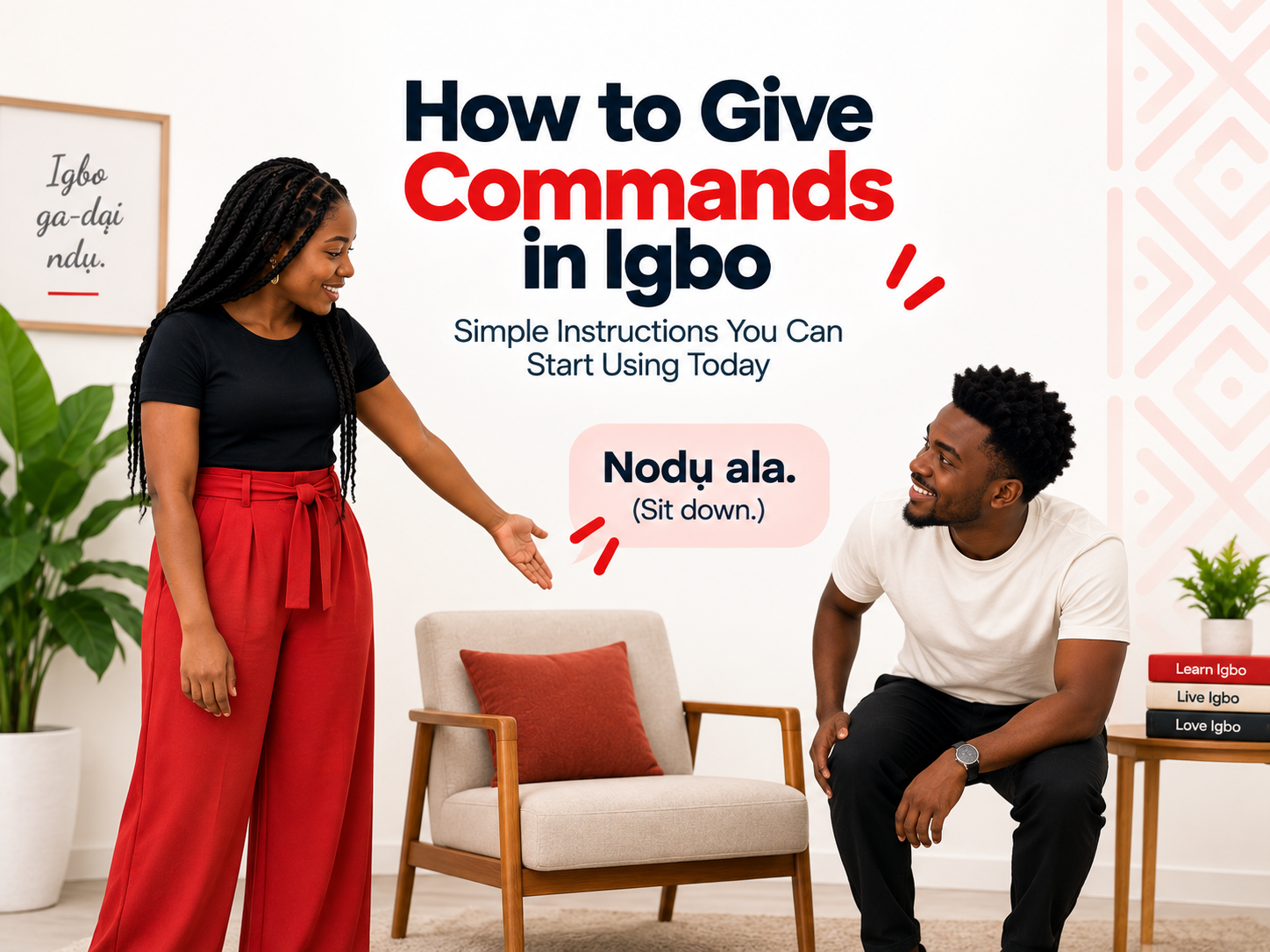
Learning a few commands in Igbo gives you simple phrases you can start using in everyday situations almost immediately.
How do you tell someone “Come here” in Igbo?
What about “Hold that money” or “Don’t touch it”?
Commands are some of the most practical Igbo sentences to learn because you can start using them almost immediately.
Here are three to begin with:
Bịa ebe a.
Come here.
Jide ego ahụ.
Hold that money.
E metụkwala ya aka.
Don’t touch it.
Notice something already?
Not all commands do the same thing.
Some tell someone to do something. Others tell someone not to do something. And some include the person, place or thing the instruction relates to.
Let’s look at these different types of Igbo commands and practise a few you can actually use.
Igbo Commands: Quick Guide
If you’re scanning, start here.
| Type of command | Igbo | English |
|---|---|---|
| Direct command | Bịa ebe a. | Come here. |
| Command involving something | Jide ego ahụ. | Hold that money. |
| Negative command | E metụkwala ya aka. | Don’t touch it. |
The main thing to notice:
Bịa ebe a tells someone what to do.
Jide ego ahụ tells someone what to do with something.
E metụkwala ya aka tells someone what not to do.
Those three ideas give you a useful starting point for recognising commands in Igbo.
Want to hear how they’re pronounced and learn the sentence pattern with an Igbo tutor?
👉 Take the free How to Build Igbo Sentences lesson on IgboLearn
1. Direct Commands in Igbo
Let’s start with a straightforward instruction:
Bịa ebe a. – Come here.
You’re telling someone to perform an action.
You might use this when calling a child, sibling, friend or someone else towards you.
Instead of thinking about grammar first, remember the situation:
Someone is over there.
You want them here.
Bịa ebe a.
That’s the phrase you need.
Try it
Imagine you’re calling someone towards you.
Don’t look at the Igbo yet.
How would you say: Come here?
Bịa ebe a.
Now say it aloud.
That’s one command you can begin recognising and using.
2. Commands That Involve a Person or Thing
A command can also tell someone to perform an action involving something else.
For example:
Jide ego ahụ.
Hold that money.
Here, you’re not simply giving an action.
There’s something involved in the instruction:
ego ahụ — that money
Think about the situation.
You’re holding some money and want someone else to take or hold it.
You say:
Jide ego ahụ.
This is useful because it shows how the commands you learn can become more specific.
You aren’t limited to one-word instructions.
You can tell someone what to do and include what the instruction relates to.
The full lesson goes further into how these kinds of sentences work. For now, focus on recognising the command as a complete phrase you can use.
3. Negative Commands in Igbo
Sometimes you don’t want someone to do something.
You want them to stop or avoid an action.
That’s a negative command.
One example from the lesson is:
E metụkwala ya aka.
Don’t touch it.
Imagine someone reaching towards something they shouldn’t touch.
You can say:
E metụkwala ya aka.
This is different from:
Bịa ebe a.
One says:
Do this.
The other says:
Don’t do this.
That distinction matters because once you start having real conversations in Igbo, you need to communicate both.
Positive vs Negative Commands
Here’s the idea to remember:
Positive command
→ tells someone to do something.
Negative command
→ tells someone not to do something.
You don’t need to memorise the full grammar behind that distinction from this article.
But you should be able to recognise the difference.
If you want to see more examples of how positive and negative meanings differ, read our guide to simple and negative sentences in Igbo.
👉 Learn how Igbo commands work in the free IgboLearn lesson
Three Igbo Commands to Remember
Let’s bring everything together.
Come here. – Bịa ebe a.
Use this when telling someone to come towards you.
Hold that money. – Jide ego ahụ.
Use this when instructing someone to hold the money.
Don’t touch it. – E metụkwala ya aka.
Use this when telling someone not to touch something.
If you remember nothing else from this page, remember those three phrases.
More importantly, remember the three ideas behind them:
Do something.
Do something involving a person or thing.
Don’t do something.
That gives you a practical foundation for understanding commands in Igbo.
Can You Recognise the Type of Command?
Try this without scrolling back up.
Bịa ebe a.
Is it telling someone to do something or not to do something?
Do something.
E metụkwala ya aka.
Positive or negative?
Negative.
The person is being told not to touch something.
Jide ego ahụ.
What is involved in the command?
Ego ahụ — that money.
Now try the translations.
What does:
Bịa ebe a.
mean?
Come here.
What about:
Jide ego ahụ.
Hold that money.
And:
E metụkwala ya aka.
Don’t touch it.
If you got them without scrolling back up, they’re already starting to stick.
Don’t Just Memorise the English Translation
It’s easy to look at:
Bịa ebe a = Come here
and think you’ve learnt it.
But there’s a better test.
Could you actually say it when you need it?
Try associating each phrase with a situation rather than only its English translation.
Someone is across the room:
Bịa ebe a.
You’re handing someone money:
Jide ego ahụ.
Someone reaches for something they shouldn’t touch:
E metụkwala ya aka.
Now you’re connecting the Igbo with an action, not just another line in your notes.
That’s much closer to how you’ll need the language in real life.
Practise These Commands Today
Here’s your challenge.
Use at least one of these commands today.
If someone is in another room:
Bịa ebe a.
If the opportunity comes up naturally:
Jide ego ahụ.
Or practise the situation aloud:
E metụkwala ya aka.
Then come back and try the other two.
You don’t need twenty new phrases today.
You need a few phrases you can actually remember and use.
Keep Building Your Igbo Sentences
Commands are only one part of learning how to express yourself in Igbo.
If you’re working through Igbo sentence formation, continue with these guides:
Simple and Negative Sentences in Igbo — see how positive and negative meanings work in practical sentences.
How to Form Simple Sentences in Igbo — learn what makes an Igbo sentence complete and why verbs matter.
How to Build Simple Igbo Sentences: Subject, Verb and Object — learn how the main parts of an Igbo sentence fit together.
Learn Igbo Online with this Free Igbo Lesson
In How to Build Igbo Sentences – Part 1, Igbo tutor Chinyere Obiyor teaches this topic as part of the wider lesson on building Igbo sentences.

Rather than giving you the rest of her explanation here, use the phrases you’ve just learnt as your starting point and continue with the tutor.
The lesson is rated ⭐ 4.9/5 on the IgboLearn app.
You can also test what you’ve learnt in the assessment and reinforce it with games, topic activities, and audio flashcards.
👉 Continue the How to Build Igbo Sentences lesson for free
Discover more from IgboLearn Blog
Subscribe to get the latest posts sent to your email.