
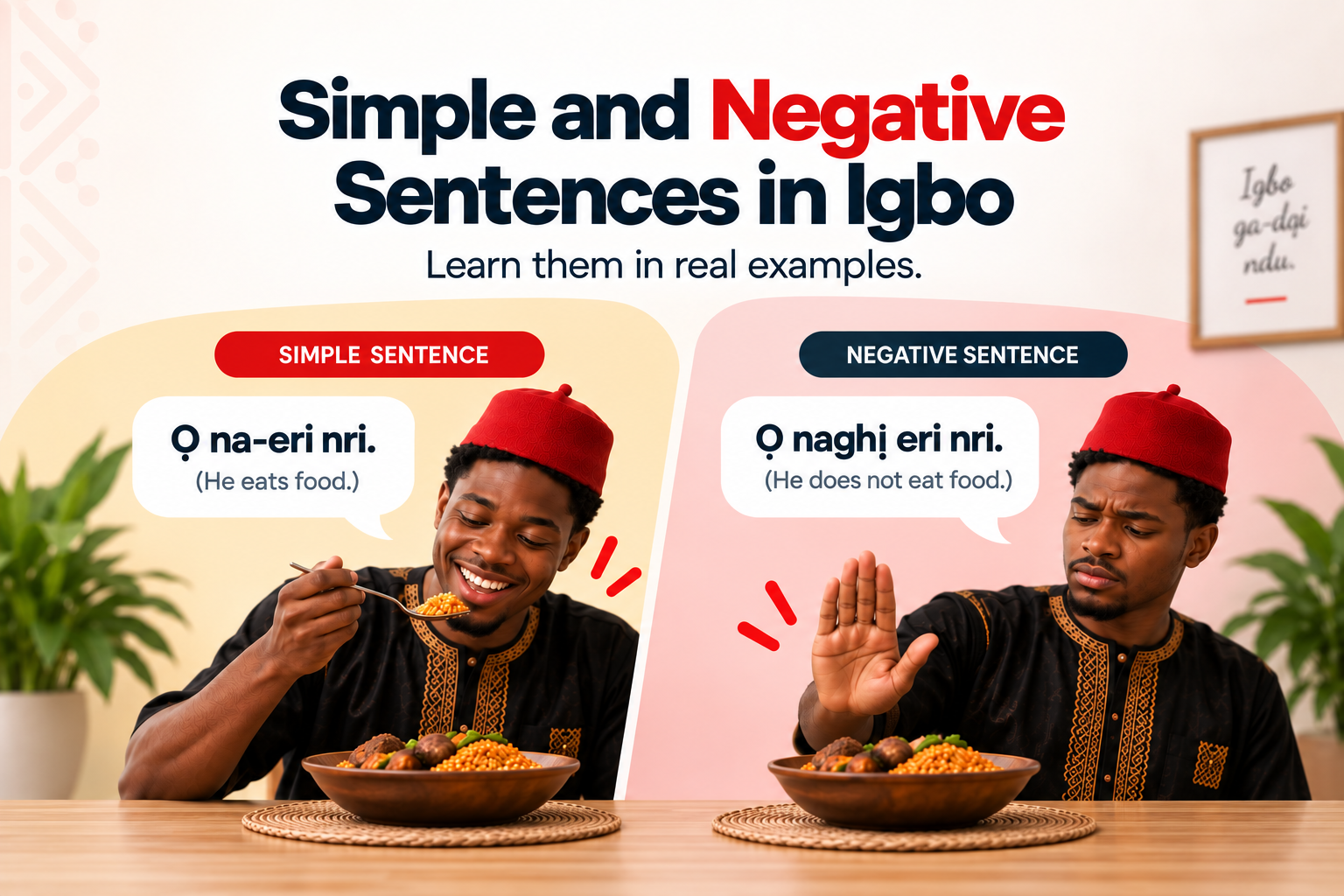
Once you start learning how to build sentences in Igbo, you’ll quickly notice that not every sentence does the same job.
You can make a simple statement:
Obi gara ahịa. (Obi went to the market.)
You can give an instruction:
Rie nri ahụ. (Eat that food.)
Or you can make that instruction negative:
Erila nri ahụ.
Do not eat that food.
So how do simple and negative sentences in Igbo work, and how can you tell the difference?
In this guide, you’ll learn about Ahịrịmfe, or simple sentences, and Ahịrịnjụ, or negative sentences. You’ll also see some of the forms used to express negative meaning in the examples taught in the lesson.
This is part of IgboLearn’s How to Build Igbo Sentences – Part 1 lesson.
If you’re following the series, you can first learn about how to form simple sentences in Igbo, subject, verb and object in Igbo sentences, and Igbo pronouns.

👉 Continue the How to Build Igbo Sentences lesson for free
What Is a Simple Sentence in Igbo?
A simple sentence in Igbo is called: Ahịrịmfe
We can break the word down:
Ahịrị — sentence
Mfe — easy or simple
In the lesson, Ahịrịmfe is explained as a short sentence with one verb and a complete meaning.
For example:
Obi gara ahịa.
Obi went to the market.
The verb is:
gara — went
Another example is:
Anyị gbara egwu.
We danced.
The verb is:
gbara — danced
Both sentences communicate a complete thought and contain one verb.
Can One Word Be a Complete Igbo Sentence?
Yes.
An Igbo sentence doesn’t necessarily need several words to communicate a complete meaning.
The lesson gives examples including:
Bịa.
Come.
Gaa.
Go.
Nọdụ.
Sit.
Bilie.
Stand up.
Take:
Bịa.
It’s only one word.
But if you tell someone:
Bịa.
they understand what you want them to do.
The sentence contains a verb and communicates a complete meaning.
So when you’re learning to build Igbo sentences, don’t assume a sentence has to be long before it is complete.
Sometimes one word does the job.
What Is a Negative Sentence in Igbo?
A negative sentence in Igbo is called: Ahịrịnjụ
The lesson connects njụ with saying no, disagreeing or rejecting something.
A negative sentence can tell us that something did not happen, should not happen or has not happened.
For example:
Erila nri ahụ.
Do not eat that food.
Another example:
Ha agaghị ụlọ akwụkwọ.
They did not go to school.
And:
Nna m ejebeghị nzukọ ụmụnna.
My father has not attended the elders’ meeting.
Notice the different ideas being communicated:
Do not eat.
Did not go.
Has not attended.
They’re all negative, but they aren’t expressing exactly the same type of negative meaning.
How Do You Make a Sentence Negative in Igbo?
This topic introduces three forms used to show negation:
-la
-ghị
-beghị
The form you encounter depends on what the sentence is communicating.
Rather than memorising these forms on their own, it helps to see them inside complete sentences.
Let’s compare some of the examples from the lesson.
“Eat” vs “Do Not Eat” in Igbo
Positive
Rie nri ahụ.
Eat that food.
Negative
Erila nri ahụ.
Do not eat that food.
Look at the two together:
Rie nri ahụ.
Erila nri ahụ.
One tells someone to eat the food.
The other tells them not to eat it.
Say both aloud a few times.
You’re not only trying to remember a grammar form. You’re learning to recognise how the meaning changes when you hear or read the sentence.
“They Went” vs “They Did Not Go” in Igbo
Here’s another comparison from the lesson.
Positive
Ha gara ụlọ akwụkwọ.
They went to school.
Negative
Ha agaghị ụlọ akwụkwọ.
They did not go to school.
Again, we’re talking about the same general action.
But one sentence says it happened.
The other says it didn’t.
Ha gara ụlọ akwụkwọ.
versus:
Ha agaghị ụlọ akwụkwọ.
This is where learning sentence formation becomes more useful than memorising individual translations.
You begin seeing how the sentence changes when the meaning changes.
👉 Practise these sentence patterns in the free IgboLearn lesson
How Do You Say “Has Not” in an Igbo Sentence?
The third negative form introduced in this topic is:
-beghị
The example is:
Nna m ejebeghị nzukọ ụmụnna.
My father has not attended the elders’ meeting.
Compare the three negative ideas we’ve seen:
Erila nri ahụ.
Do not eat that food.
Ha agaghị ụlọ akwụkwọ.
They did not go to school.
Nna m ejebeghị nzukọ ụmụnna.
My father has not attended the elders’ meeting.
One is a negative instruction.
One tells us something did not happen.
One tells us something has not happened.
Learning the forms inside sentences makes these differences much easier to recognise than trying to memorise -la, -ghị and -beghị on their own.
Simple vs Negative Sentences in Igbo
Let’s put the examples together.
| Igbo | English | Type |
|---|---|---|
| Obi gara ahịa. | Obi went to the market. | Simple sentence |
| Anyị gbara egwu. | We danced. | Simple sentence |
| Bịa. | Come. | Simple sentence |
| Rie nri ahụ. | Eat that food. | Positive instruction |
| Erila nri ahụ. | Do not eat that food. | Negative sentence |
| Ha gara ụlọ akwụkwọ. | They went to school. | Positive sentence |
| Ha agaghị ụlọ akwụkwọ. | They did not go to school. | Negative sentence |
| Nna m ejebeghị nzukọ ụmụnna. | My father has not attended the elders’ meeting. | Negative sentence |
Don’t just read the table.
Look for the differences.
Can you identify the positive and negative versions of the same idea?
Can you recognise -la, -ghị and -beghị in the examples?
Practise Positive and Negative Igbo Sentences
One useful way to practise is in pairs.
Say:
Rie nri ahụ.
Then:
Erila nri ahụ.
Now:
Ha gara ụlọ akwụkwọ.
Then:
Ha agaghị ụlọ akwụkwọ.
Don’t focus only on the English translation.
Look at what changes in the Igbo.
Say both versions aloud and see if you can recognise which one is negative without looking at the English underneath.
That’s the skill you’re trying to build.
Learn the Grammar Inside the Sentence
You could leave this topic remembering:
Ahịrịmfe = simple sentence
Ahịrịnjụ = negative sentence
But it’s more useful to remember the examples too.
Instead of only remembering -la, remember:
Erila nri ahụ.
Instead of only remembering -beghị, remember:
Nna m ejebeghị nzukọ ụmụnna.
The grammar explains what’s happening.
The sentence shows you how it works.
Continue Learning Igbo Sentence Types
You now know two sentence types introduced in this part of How to Build Igbo Sentences:
Ahịrịmfe — simple sentence
Ahịrịnjụ — negative sentence
You’ve also seen that a simple sentence can be as short as Bịa, and you’ve encountered -la, -ghị and -beghị in negative examples taught in the lesson.
The next topic continues with other types of Igbo sentences, so you can keep building on what you’ve learnt instead of trying to understand everything at once.
How to Build Igbo Sentences – Part 1 is taught by Igbo tutor Chinyere Obiyor and is rated ⭐ 4.9/5 on the IgboLearn app.
You can also test what you’ve learnt with the lesson assessment and reinforce it with practice activities, games and audio flashcards.
👉 Continue How to Build Igbo Sentences – Part 1 for free
Then practise the positive and negative pairs until you can recognise the difference without needing the English underneath.
That’s when the grammar starts becoming something you can actually use.