
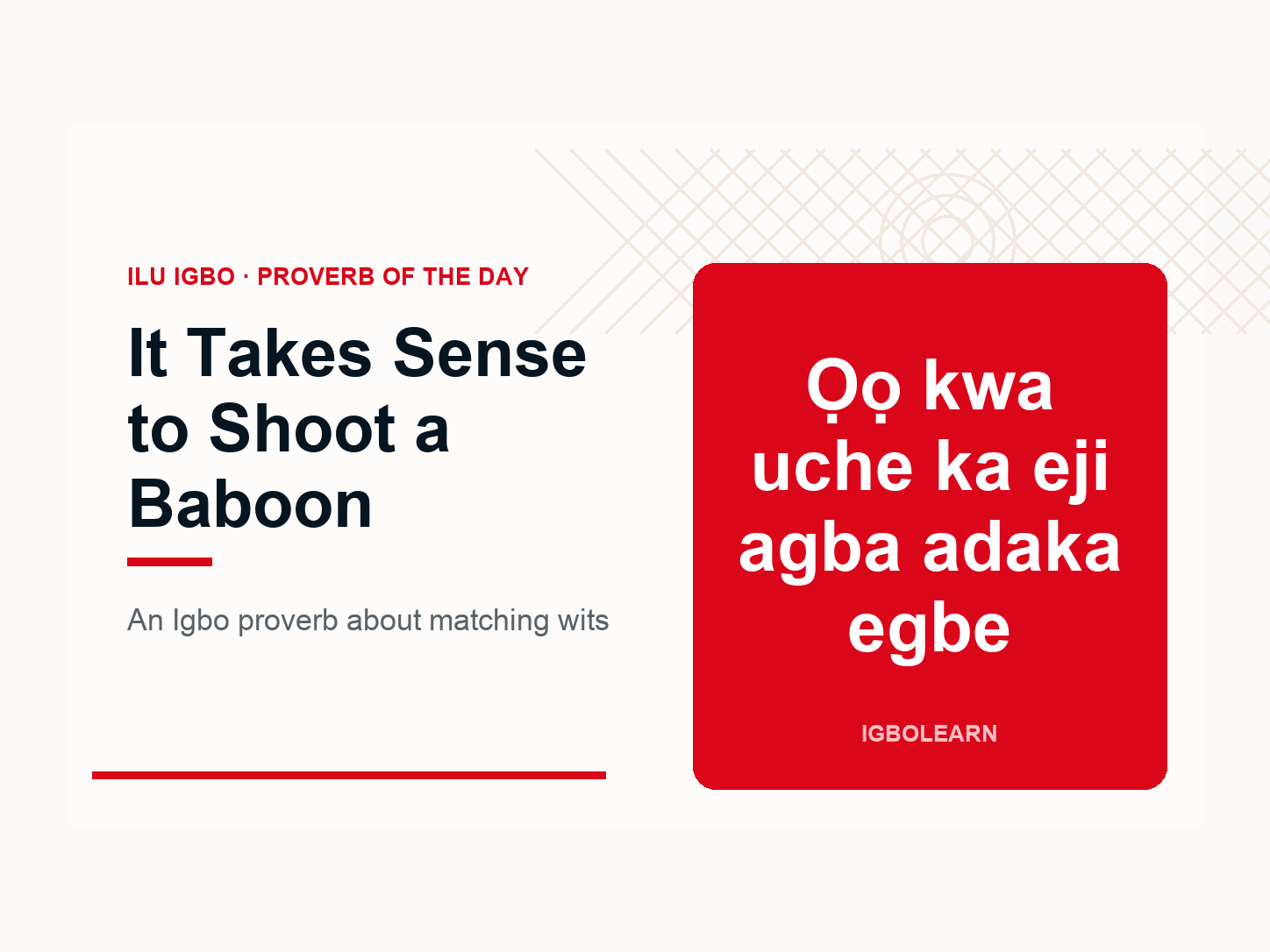
Ọọ kwa uche ka eji agba adaka egbe.
Literally: he who is shooting at a baboon has to be smart. What it means: it takes sense to deal with someone who has sense of their own.
This is today’s proverb in the IgboLearn app, and it is a good one to start with, because it is not really about hunting at all.
Why a baboon?
The choice of animal is the whole proverb. Àdakā — baboon — is not prey that stands still. A baboon watches. It learns the shape of a hunter, notices the direction he came from, remembers the sound of the thing he is carrying. Get it wrong once and the troop knows you.
So shooting a baboon is not a test of your aim. It is a test of whether you can think faster than something that is also thinking. Put a clever hunter against a clever animal and the gun stops being the deciding factor.
That is the warning the proverb carries: the advantage you think you have may not be the one that decides it.
The word doing the work: uche
Uchè is the pivot of the sentence. The IgboLearn dictionary glosses it as mind; thought, and in everyday use it stretches across sense, intention, judgement and plan — the whole business of thinking something through rather than simply reacting.
You will meet it inside Igbo names, which is where most learners first see it without recognising it:
- Uchenna — the father’s will, the father’s intention
- Uchendụ — the thought of life
Once uche is in your vocabulary, a surprising number of names stop being sounds and start being sentences.
The proverb, word by word
| Igbo | English |
|---|---|
| uchè | mind; thought; sense |
| àdakā | baboon |
| egbè | gun |
| agba | to shoot, to fire |
The opening Ọọ kwa is a spoken emphatic — closest to it is really or it is indeed at the head of a sentence. You will see the proverb written several ways; Igbo proverbs travel by mouth, and the spelling settles differently in different places.
One word, two animals: egbe
Here is the detail worth keeping. Look up egbe and you get two entries:
- egbe — kite, the bird of prey
- egbè — gun
Same letters. Different tone. In Igbo, pitch is not decoration — it is part of the word, the way a consonant is. Say egbe on the wrong pitch and you have swapped a firearm for a hawk.
This is also why a proverb written down is only half of it. The page cannot show you the tones, and the tones are where half the meaning lives.
When would you actually say it?
You reach for this one when someone is underestimating their opponent. A younger trader who thinks he will outmanoeuvre an older one. A person who assumes a quiet colleague is a simple one. Anybody walking into a negotiation holding only confidence.
Said to that person, it is a caution: the thing you are aiming at is aiming back. Said afterwards, when they have been outplayed, it is a shrug with a lesson in it.
Igbo proverbs are rarely deployed as decoration. An elder drops one into a dispute to end an argument without naming anyone, and everybody present understands exactly who it was about. That is the function: to say the hard thing sideways.
Questions people ask
Literally, he who is shooting at a baboon has to be smart. It means it takes sense to deal with someone who is just as clever as you are.
Mind or thought. In everyday use it covers sense, intention, judgement and plan. It appears inside names such as Uchenna and Uchendụ.
Both. Egbe with one tone pattern is the kite, a bird of prey; egbè with another is a gun. The pitch distinguishes them, which is why Igbo tone is part of the word rather than an accent on it.
Ilu. Proverbs carry a great deal of weight in Igbo speech, and an elder will often use one to settle a dispute without naming anyone directly.
A new proverb every day. IgboLearn serves one ilu a day with the audio, so you hear the tones rather than guess at them. Look up uche or egbe in the dictionary, or start with the free app.
Discover more from IgboLearn Blog
Subscribe to get the latest posts sent to your email.