
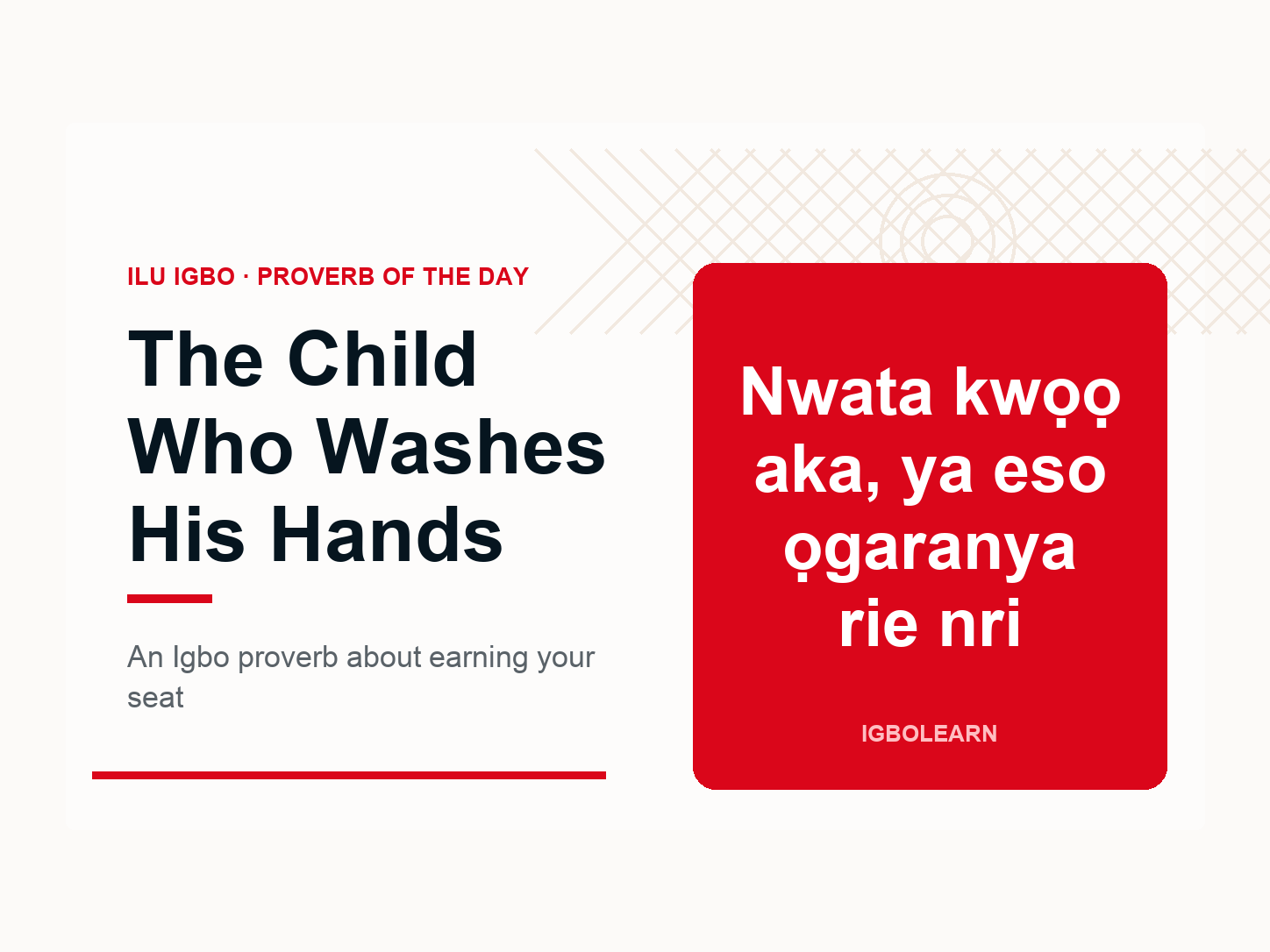
Nwata kwọọ aka, ya eso ọgaranya rie nri.
If a child washes his hands, he eats with the wealthy.
Chinua Achebe put a version of this in Things Fall Apart, which is how most readers outside Igboland first meet it. It is one of the few proverbs almost every Igbo speaker can recite.
Word by word
| Igbo | English |
|---|---|
| nwata | child |
| kwọọ aka | washes the hands |
| ya eso | let him accompany |
| ọgaranya | a wealthy person |
| rie nri | eat food |
Note kwọọ with its doubled vowel — the same lengthening that turns chekwa into an order, and the same one in chọọ. Igbo marks the conditional and the imperative by stretching the vowel rather than by adding a word.
It is not about hygiene, and not really about children
Igbo food is eaten with the hand, from shared dishes. Washing before you eat is not a nicety — it is the entry condition. A child with unwashed hands is not a slightly grubby child; he is a child who cannot be allowed near the food.
So the proverb is about a standard anyone can meet. The child is not asked to become older, richer or better born. He is asked to wash his hands — which costs nothing, which is entirely within his control, and which he can simply do.
That is the argument. In a society organised almost entirely by seniority, here is a sentence saying that a seat at the senior table can be earned by conduct rather than waited for by age.
Ọgaranya, and the honesty of the dictionary
Ọgaranya is a wealthy person. The IgboLearn dictionary’s example sentences around it are a small social history in themselves: the rich man he is today is because of his efforts as a child, and, flatly, the rich and poor do not eat from one plate.
Hold those two next to the proverb and you have the whole tension. The rule is that the rich and the poor do not share a plate. The proverb is the exception, and it names its own price.
How it gets used
To a young person who has done well, as congratulation and as explanation at once — this is why you are here. It is what an uncle says when a nephew’s name comes up in a conversation he would once have been too junior to join.
And occasionally to the rest of the room, as an argument: let him sit. He washed his hands.
Questions people ask
If a child washes his hands, he eats with the wealthy. It means that merit and good conduct can earn a young person a place among their seniors.
Igbo food is eaten by hand from shared dishes, so washing is the condition for being allowed to eat at all. The proverb picks a standard that costs nothing and is entirely within the child’s own control.
Yes — Chinua Achebe uses a version of it, which is how most readers outside Igboland first encounter it.
A proverb a day, with the audio. For a proverb about room at the top rather than a seat at the table, see egbe bere ugo bere. Get the free IgboLearn app.
Discover more from IgboLearn Blog
Subscribe to get the latest posts sent to your email.