
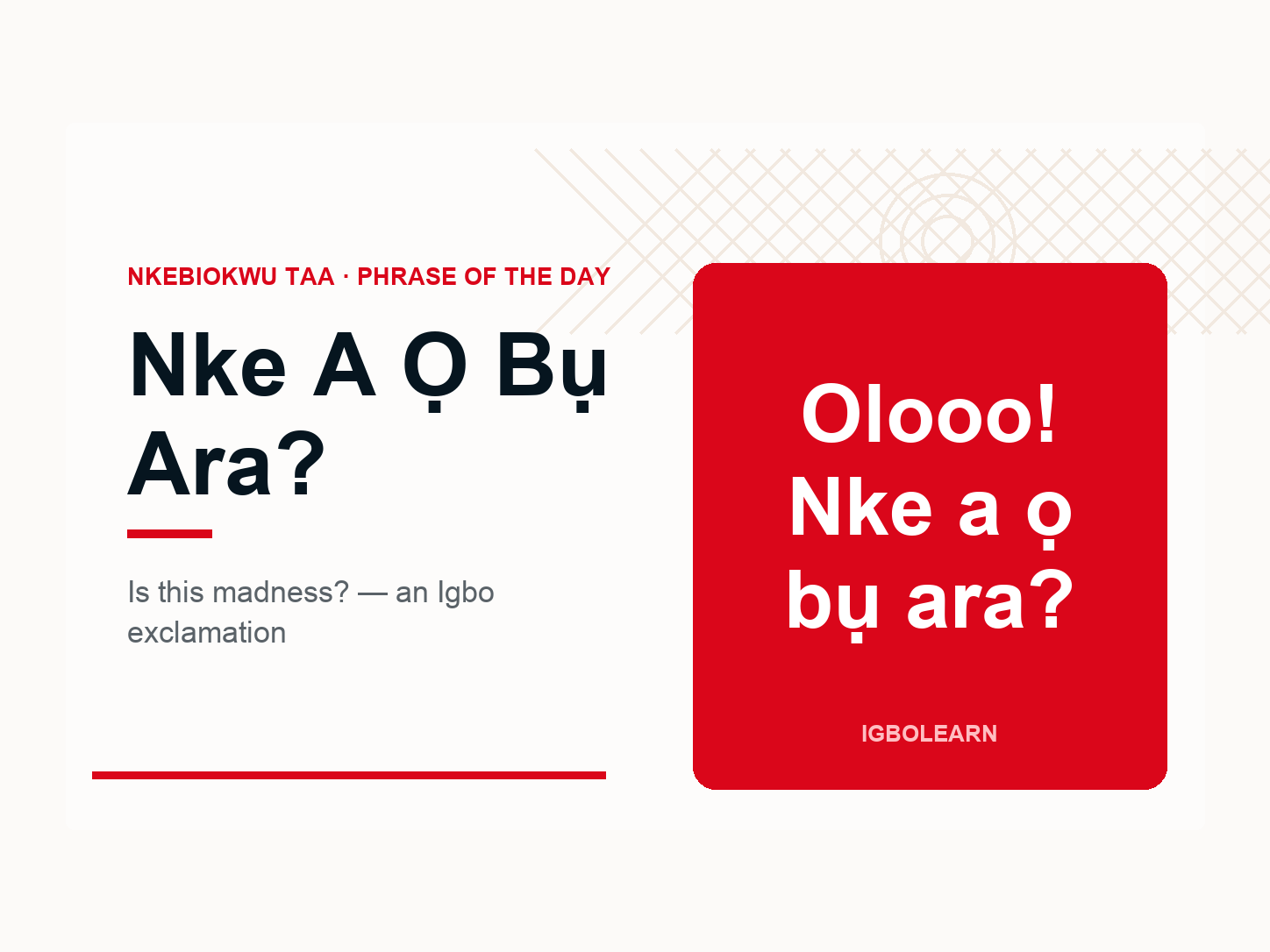
Olooo! Nke a ọ bụ ara? — Oh my goodness! Is this madness?
Today’s phrase in the IgboLearn app, and one of those sentences that teaches more grammar than it has any right to for its length.
Piece by piece
| Igbo | English |
|---|---|
| Olooo! | an exclamation — oh my goodness |
| nke a | this one; this |
| ọ | it (and here, the question) |
| bụ | is |
| ara | madness |
The small word doing the heavy lifting
Take the ọ out and you get Nke a bụ ara — this is madness. A flat statement.
Put it back and the sentence becomes a question. Igbo does not need to reorder anything, and it does not need a rising voice at the end the way English does. One syllable, dropped in before the verb, and the whole sentence changes its job.
Worth practising on anything:
- Nke a bụ ụlọ gị. — This is your house.
- Nke a ọ bụ ụlọ gị? — Is this your house?
Careful with ara
The IgboLearn dictionary lists ara twice, and they are not the same word:
| Igbo | English | In a sentence |
|---|---|---|
| ara | madness; insanity | Ara dị na be ha. — Madness runs in their family. |
| ara | breast | Ọ na-enyocha ara ya ọnwa ọbụla. — She examines her breast every month. |
They are told apart by tone and by the company they keep. This is the single most important habit to build early in Igbo: when a word looks familiar, check which one it is before you commit. Two words spelled the same are the rule here, not the exception.
When you would say it
Not at someone’s mental health. Nke a ọ bụ ara? is aimed at a situation — a bill, a queue, a price, a decision someone has just announced. It is the Igbo equivalent of are you serious?, and like that phrase it is mostly rhetorical.
The Olooo! in front is what marks it as exasperation rather than an actual enquiry. Said flat, without it, the sentence is colder than you probably mean.
Hear it said properly. Look up ara in the IgboLearn dictionary, or get the free app for a phrase a day with the audio.
Discover more from IgboLearn Blog
Subscribe to get the latest posts sent to your email.