
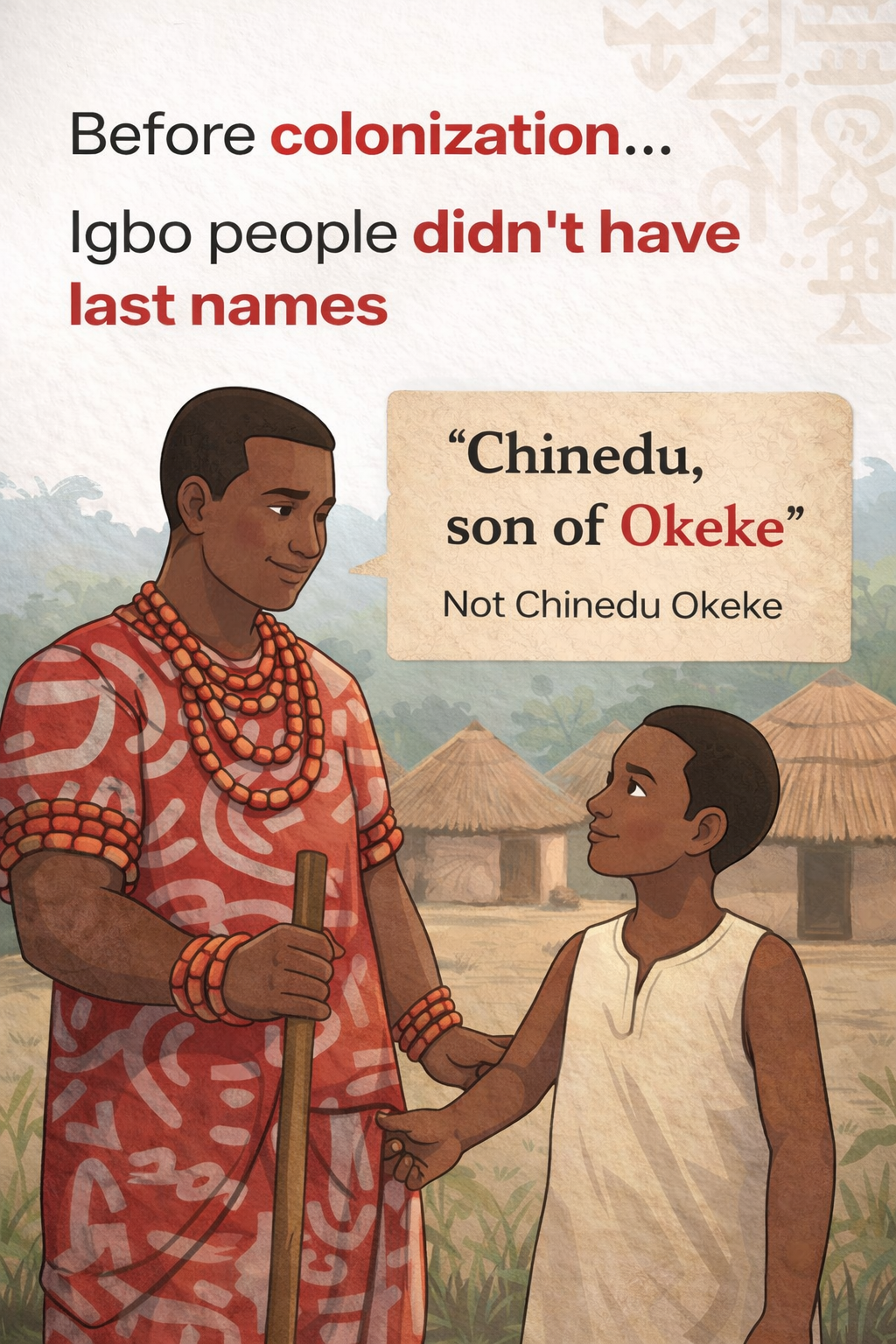
Did you know your Igbo surname may not actually be a “family name”?
Before colonial influence, the Igbo people did not use fixed last names the way we do today.
Instead, identity was fluid, deeply cultural, and rooted in lineage — not in a permanent surname.
In this article, you’ll learn:
- The true origin of Igbo last names
- How naming worked before colonization
- Why your surname may have originally been a first name
- What this means for your identity today
How Traditional Igbo Naming Actually Worked
In pre-colonial Igbo society, there was no “first name + last name” system.
Instead, people were identified using:
- A given name (personal name)
- Their father’s name
- Their village or kindred (umunna)
For example, instead of:
Chinedu Okeke
You would hear:
“Chinedu nwa Okeke” (Chinedu, child of Okeke)
This system made identity:
- Relational (connected to family)
- Contextual (based on origin)
- Dynamic (not fixed across generations)
Why Igbo Names Changed Every Generation
One of the biggest differences from modern naming:
Names were not inherited as fixed surnames
Let’s break it down:
- Okeke has a son → Chinedu → He is called Chinedu nwa Okeke
- Chinedu has a son → Obinna → He becomes Obinna nwa Chinedu
Notice what’s happening?
The “last name” changes with each generation
There was no permanent family surname.
When Did Igbo Surnames Start?
The use of fixed surnames began during:
- British colonial rule in Nigeria
- Missionary education
- Church and school record systems
Organizations like the Church Missionary Society needed:
- Stable identities
- Written records
- Consistent naming formats
So people adapted.
Father’s names became permanent surnames
The Truth About Your Igbo Surname
Many Igbo last names today are actually:
Original personal (first) names
Examples:
- Okeke
- Nwoye
- Udeogu
- Chukwuemeka
These names:
- Were once given to individuals
- Carried meaning, history, and belief
- Later became family surnames due to colonial systems
Traditional vs Modern Igbo Last Name
| Traditional Igbo Naming | Modern Naming System |
|---|---|
| No fixed surname | Fixed last name |
| Changes every generation | Passed down unchanged |
| Based on lineage | Based on family unit |
| Community identity | Individual identity |
What This Means for You Today
You don’t have to abandon modern naming — but you can reconnect with your roots.
A powerful way to do that:
- Official name: Chinedu Udeogu
- Cultural identity: Chinedu nwa [Father’s Name]
This keeps:
- Legal structure ✅
- Cultural identity ✅
Why This Matters (Especially for Igbo Identity)
Understanding Igbo naming is about more than names. Check out our other article on Igbo Names and Identity.
It’s about:
- Knowing where you come from
- Understanding your lineage
- Preserving cultural identity in a modern world
Your name carries:
- Philosophy
- History
- Spiritual meaning
Learn Igbo the Right Way
At IgboLearn, we go beyond vocabulary.
We teach:
- Real Igbo meanings
- Cultural context
- How to actually speak and think in Igbo
👉 Start learning today and reconnect with your roots.