
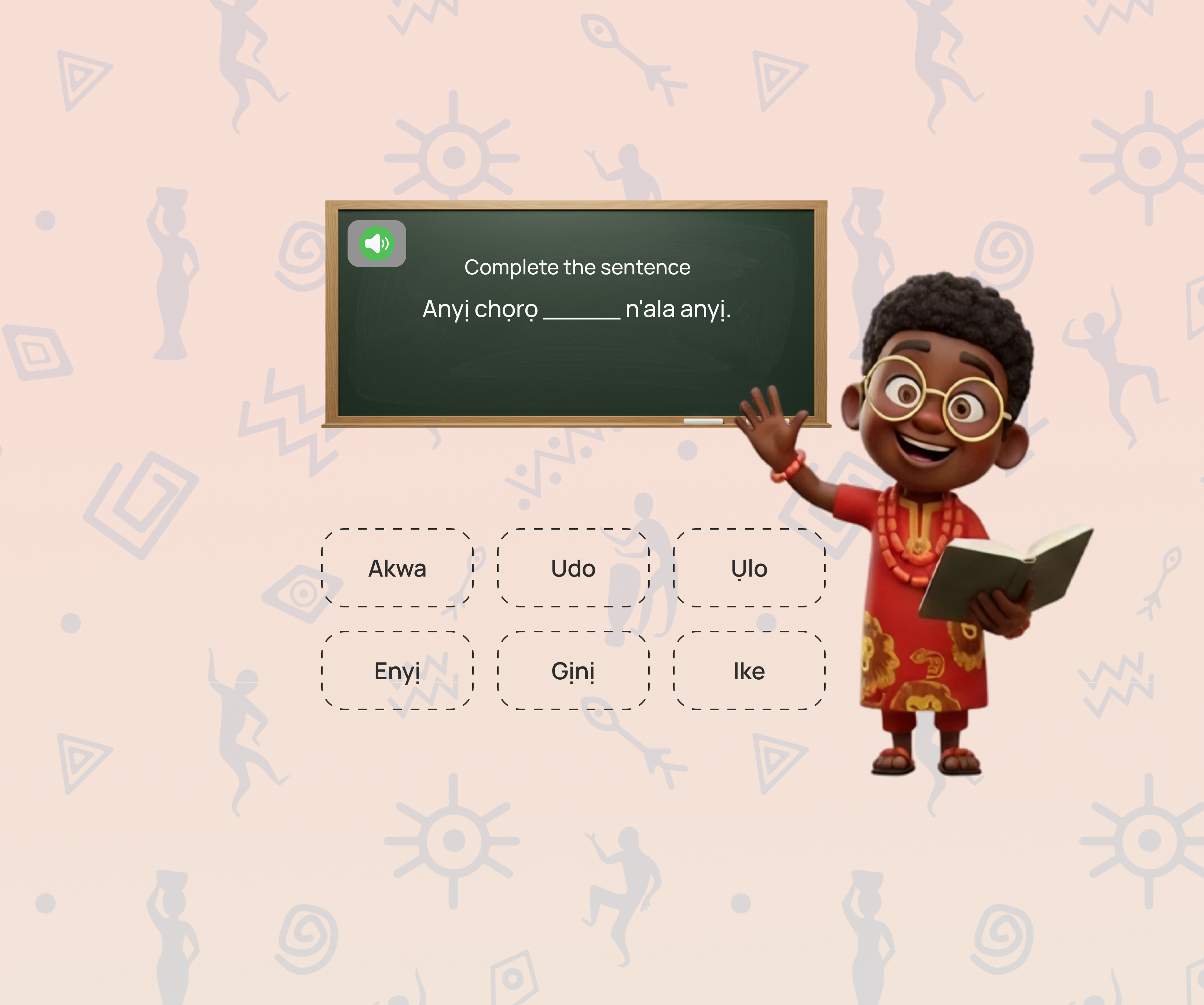
While designing IgboLearn, I wasn’t just thinking about how we wanted to teach vocabulary or grammar. I was thinking about creating an experience that would truly make learning stick. Language is more than memorizing words, it’s about connecting meaning, culture, and emotion. And one of the strongest ways to achieve that is through storytelling in Igbo. As we say in Igbo, “Asụsụ bụ ndụ, onye na-asụ asụsụ na-ebi ndụ abụọ” (Language is life, and the one who speaks a language lives twice). That’s the spirit I wanted to capture: through visual storytelling, learners don’t just see words, they feel them, live them, and carry them with pride.
In my first blog post, “Designing for Culture and Connection: My Journey with IgboLearn”, I shared how deeply personal this project is for me. I talked about rediscovering my roots, learning before teaching, and designing with empathy for people who also want to connect with the Igbo language. This next part of the journey is about how design choices — infographics, puzzles, and avatars — help bring that vision to life.
Why Text Alone Isn’t Enough
If you’ve ever tried to learn a new language just by reading, you probably know how quickly it can feel overwhelming. Long lists of words or rigid grammar rules don’t always stick. That’s because the brain isn’t wired to hold onto abstract information without context.
Visuals add that missing context. When a learner sees an image, a playful puzzle, or even a character guiding them, the information becomes a story — something the brain can connect with, not just memorize.

Infographics: Learning at a Glance
One of the features I’m most excited about in IgboLearn is the use of infographics. Instead of long explanations, we break down key concepts into simple, visual snapshots.
For example, imagine trying to understand the difference between two Igbo words that sound similar. Instead of reading a paragraph, you see an infographic with visuals, examples, and quick notes. It’s faster, clearer, and easier to remember. And when combined with storytelling in Igbo, these visuals don’t just teach definitions—they connect words to real-life experiences, emotions, and culture, making the learning journey more memorable.

Puzzles: Making Learning Playful
Learning should feel less like a task and more like an experience. That’s why puzzles are part of the lesson flow in IgboLearn.
After watching a video lesson, learners can solve short puzzles that reinforce what they’ve just learned. This turns passive watching into active engagement. And when users “earn” progress through these puzzles, they don’t just retain more, they feel a sense of achievement that pushes them forward.

Avatars: Connection Through Characters
Every learner needs a guide. For IgboLearn, we’re introducing an avatar, a friendly companion who shows up in different moods and scenarios. Just like Duolingo’s owl, this avatar makes the experience feel human and personal.
It’s not just about adding fun, it’s about building a relationship. When a learner sees the avatar celebrating with them, encouraging them after a mistake, or reminding them to keep going, the experience feels less like software and more like a shared journey. And when paired with storytelling in Igbo, the avatar becomes more than a guide, it becomes a cultural friend who carries learners into proverbs, folktales, and everyday expressions that bring the language to life.

Why This Matters for IgboLearn
At its heart, IgboLearn is about more than teaching words. It’s about helping people connect with identity, culture, and community. By blending infographics, puzzles, and avatars, we’re using visual storytelling to make learning memorable and meaningful.
For me, this is also a continuation of the journey I shared in my first article, “Designing for Culture and Connection.” If you haven’t read it yet, I encourage you to, it’s the foundation for everything I’m building with IgboLearn today.
Final Thoughts
Visual storytelling matters because learning is more than input and output. It’s about connection. Whether it’s a quick infographic that simplifies a lesson, a puzzle that challenges the mind, or an avatar that encourages consistency, each design choice in IgboLearn is intentional.
Because at the end of the day, we’re not just building an app — we’re building a bridge between language, memory, and culture.