
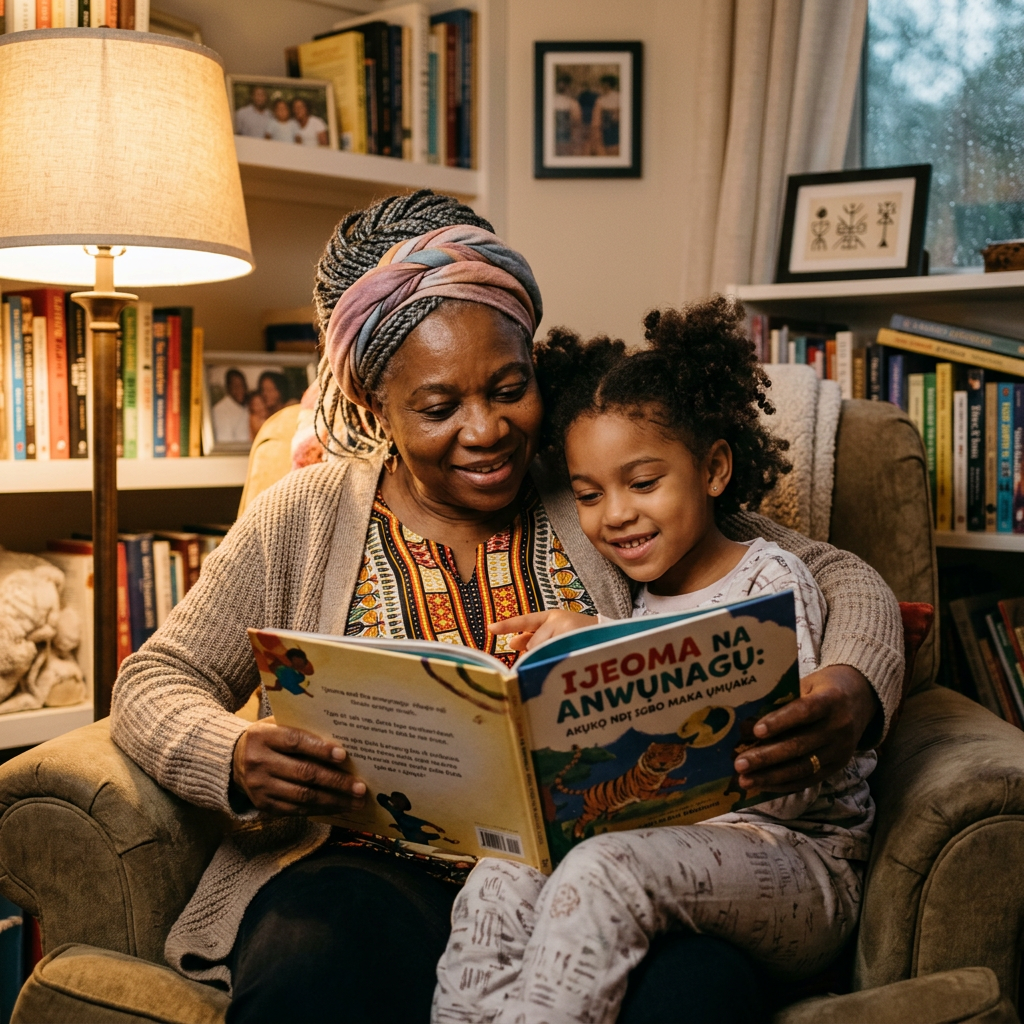
Your child says “Mama, Daddy” in English, and you wonder if it’s already too late. It isn’t. Research on bilingual development shows children can pick up a second language as late as age 8 with near-native fluency and even older with strong proficiency. The window is wider than the panic of toddler-parenthood makes it feel.
The harder question isn’t can they learn Igbo. It’s: how do you fit it into a life that’s already full?
Here’s what works for diaspora families, based on what linguists call the “one parent, one language” approach and what the rest of us call “trial, error, and patience.”
Pick a routine, not a curriculum
The instinct is to download an app, schedule lessons, and treat Igbo like piano practice. That fails fast. Kids resist anything that feels like school.
What works instead:
- Morning greetings in Igbo only: Ụtụtụ ọma, nwa m. Repeated daily, this sticks within a month.
- One meal a week: Sunday dinner is Igbo-only. Everyone — including you — must order, ask, complain in Igbo.
- Bedtime Igbo story: two minutes, every night, even if it’s the same one for two weeks.
Three small anchors beat one ambitious lesson plan you’ll abandon by week three.
Use the grandparents
The diaspora’s greatest underused resource: people on WhatsApp who already speak Igbo fluently and will talk all day for free.
Have your child video-call their grandparents once a week, in Igbo only. Even if they understand 10% at age four, by age ten it’ll be 60%, and the relationship — the real reason you wanted them to learn will be unbroken.
Choose songs and shows over apps for the youngest
Under age five, kids learn from music and faces, not screens-with-quizzes. Search YouTube for:
- Akwukwo onụ ọgụgụ — counting songs in Igbo
- Igbo nursery rhymes — there are surprisingly many
- Igbo Children’s Bible stories, if that fits your home
When they’re 5+, that’s when an app like IgboLearn starts to click — they can read, they understand quizzes, they enjoy the dopamine of getting an answer right.
Don’t shame mistakes but instead celebrate attempts
The fastest way to kill a child’s Igbo is to correct them every time they get a word wrong. Imagine if every English sentence you spoke as a four-year-old was corrected — you’d stop talking too.
When your child says “M na-eje shopu” (I am going to the shop — code-switched), the right response isn’t “It’s ahịa, not shopu!” The right response is “Ọ dị mma! Ka anyị gaa.” You repeat the word naturally; they hear the correct version; they keep talking.
Speaking comes first, accuracy follows.
Set a realistic expectation
Your child probably won’t speak Igbo like a Lagos teenager. That’s okay. They might end up receptively fluent — understanding everything, replying in English — and that alone preserves the bridge to their grandparents, their cousins, their heritage.
If they end up productively fluent (speaking confidently too), beautiful. But don’t measure success only by that.
IgboLearn for families
If you want a guided structure for ages 5+, IgboLearn has a kids mode with shorter lessons, picture puzzles, and tone-marked audio recorded by native speakers. A parent dashboard shows their progress so you can connect at dinner — “What new word did you learn today?”