
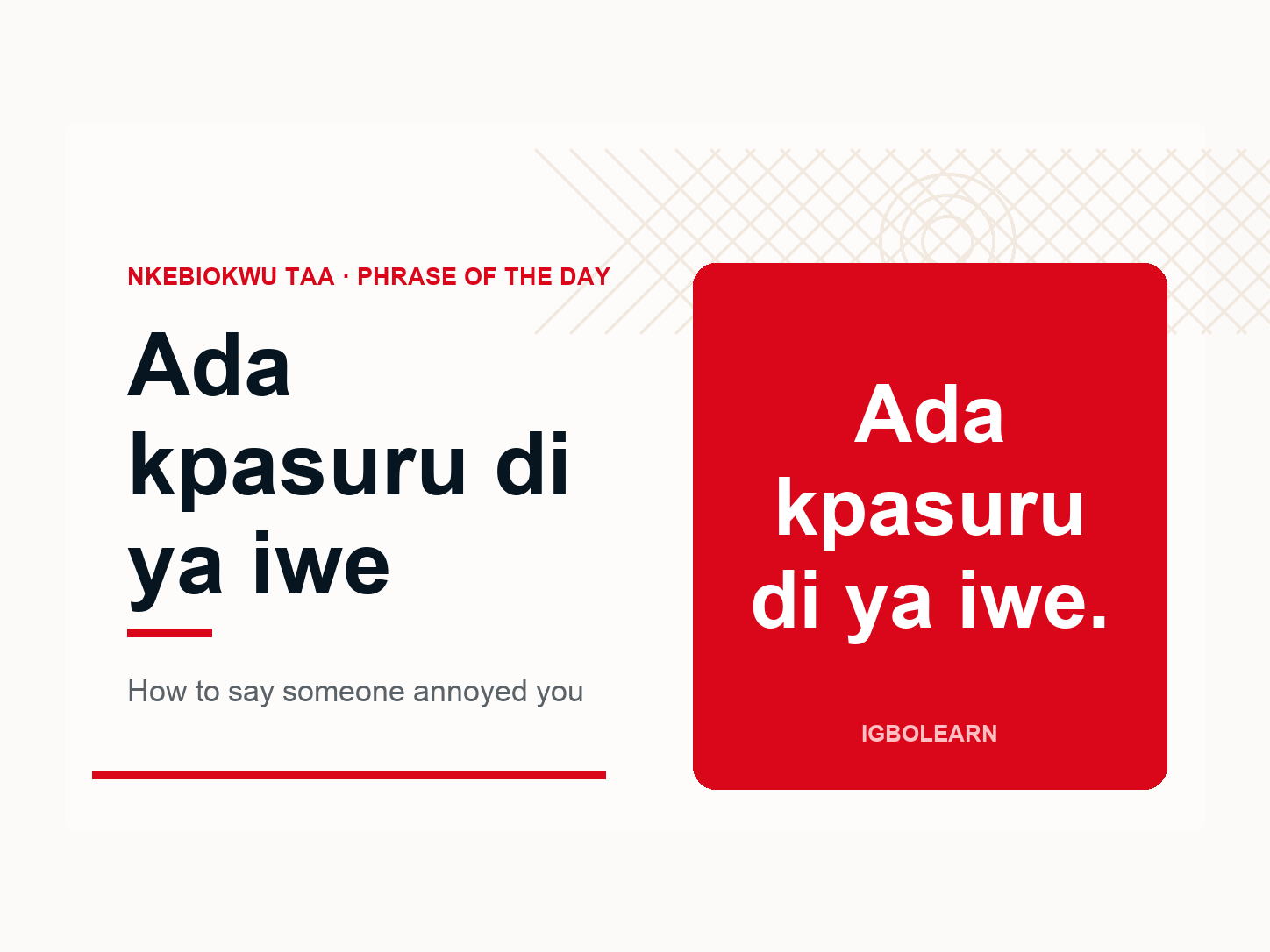
Ada kpasuru di ya iwe.
Ada annoyed her husband.
Today’s phrase in the IgboLearn app, and a useful one to own — not because you will want to announce that somebody is annoyed, but because of the grammatical trick holding it together.
The verb comes in two halves
The dictionary lists kpasu iwē as a single entry: provoke to anger; annoy; enrage; make violently angry. But look at where the two halves actually land in the sentence:
| Ada | kpasuru | di ya | iwe |
|---|---|---|---|
| Ada | provoked | her husband | anger |
The verb opens, the person it was done to sits inside it, and the second half closes the sentence. The English has to say annoyed her husband as a block. Igbo wraps the husband in the verb.
Once you have seen this you start noticing it everywhere. A great many Igbo expressions are a verb plus a noun that belong together but do not sit together.
The pieces
| Igbo | English |
|---|---|
| kpasu | to provoke |
| iwe | anger; annoyance; irritation; vexation |
| di | husband |
| ya | his, her, its |
| -ru | marks the action as completed |
So the sentence is closer to Ada provoked her husband to anger than to the flat English annoyed. Igbo is naming the thing that was raised in him.
Swapping the person
Because the middle slot is just a person, you change who was annoyed by changing that slot and leaving the rest alone:
- Ada kpasuru m iwe. — Ada annoyed me.
- Ada kpasuru ya iwe. — Ada annoyed him or her.
- Ada kpasuru anyị iwe. — Ada annoyed us.
That is the pattern earning its keep. One sentence learned, a whole set of sentences available. If the pronouns are not yet solid, Igbo pronouns: I, you, we and they is the place to fix that.
Watch the word di
One small trap. Di here means husband. But the dictionary also carries dì, a verb meaning to endure — same letters, different tone, unrelated meaning.
Igbo does this constantly, and it is not a quirk to be apologised for: the pitch is part of the word. Learning Igbo from text alone means learning half of each word and guessing the rest. It is the single strongest argument for listening before reading.
Saying it about yourself
If you want the far more useful everyday version — being annoyed rather than causing it — iwe is still the word you need. It is the noun at the centre of the whole area: anger, annoyance, irritation, vexation.
For the surrounding vocabulary of saying how you feel, see expressing needs and feelings in Igbo.
A phrase a day, with the audio. IgboLearn gives you a phrase every morning and a native recording to copy, which is the only way the tones go in. Look up iwe in the dictionary, or start with the free app.
Discover more from IgboLearn Blog
Subscribe to get the latest posts sent to your email.