
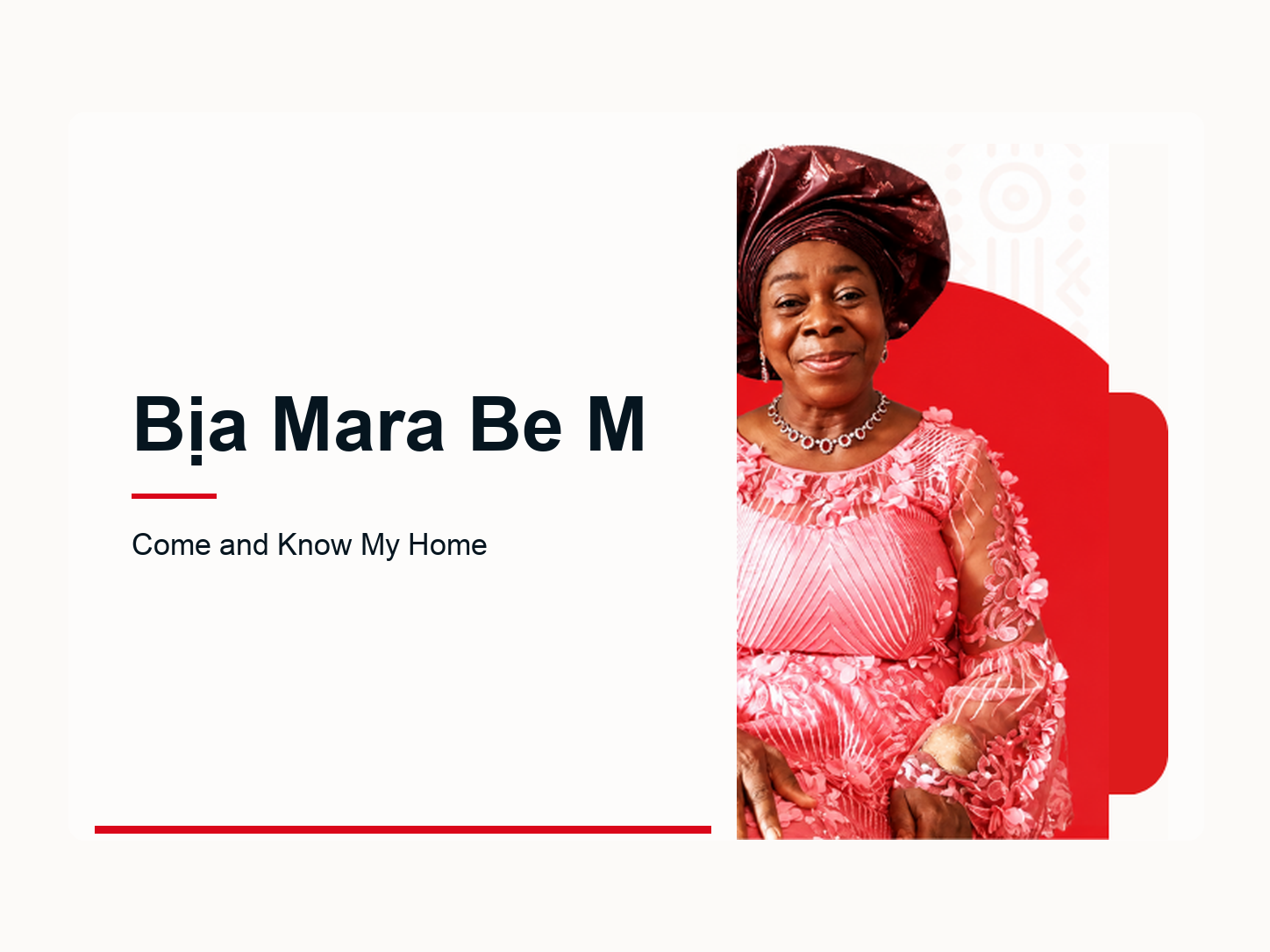
Most of the stage names in this lesson are noun phrases. This one is a sentence — something somebody says — and it is short enough that you can already read it.
Reading It Word by Word
Bịa — come. Mara — the verb ma, know. Be — home. M — my.
Come and know my home. Two bare verbs in a row, then the thing being spoken about — and both verbs are imperatives, which in Igbo means they carry no tense marker at all.
You have met be before without being told. The dictionary’s sentence for welcome uses it: Mmadụ bịa be gị, i sị ya nnọọ. — When someone comes to your house, you tell him welcome. There it is — be gị, your home.
What the Stage Is For
By this point the couple are married. Ịgba Nkwụ has happened; the bride price stage has passed. So what is left to show anyone?
Where the bride is going to live. Her family comes to see the home, meet the household, and know the place by sight rather than by description.
Note the verb. Not come and see — come and know. Ma is knowledge, not observation. The invitation is to become familiar with a place, not to inspect it.
Which matters practically: once her family knows the home, she is not somewhere unknown to them. That is reassurance built into the sequence.
The Grammar Worth Noticing
Bịa mara puts two commands side by side with nothing joining them. Igbo does this comfortably, and you have seen it already:
- Gaa gwa ha mee ọsọọsọ. — Go and tell them to be fast.
- Bịa ka anyị sịa asịrị. — Come, let’s gossip.
Gaa gwa — go, tell. No and between them. English needs the conjunction; Igbo just runs the verbs together.
And m at the end is the possessive, in the position you learned from aha m (my name) and ọrụ m (my work) — after the thing possessed.
Why This One Is Worth Memorising
Of the ten stage names, this is the one you can use outside a wedding. Bịa mara be m is a genuine invitation — come and know my home — and it is a warm thing to be able to say.
It also happens to drill three things at once: the imperative, verbs in series, and the possessive position. Four words doing a lot of teaching.
Learn the Full Sequence
Bịa Mara Be M is the eighth of ten stages, between the bride price and the signing of documents.
👉 Learn Stages of Marriage in Igbo Culture free on IgboLearn
🎤 Practise inviting someone home in a live Igbo conversation
Related reading: both verbs in Bịa mara are imperatives, and how to give commands in Igbo covers the bare verb form they are using. The dictionary sentence quoted above sits at the centre of how to say welcome in Igbo, and once her family is through the door, household items in Igbo names what they are looking at.
Come and know my home. Bịa is come, mara is from ma, to know, be is home and m is my — four words, and unlike the other stage names it is a sentence somebody actually says.
It shows where the bride is going to live. Her family comes to see the home, meet the household and know the place by sight rather than by description — so once they know it, she is not somewhere unknown to them. It is the eighth of ten stages, between the bride price and the signing of documents.
Igbo runs imperatives together without a conjunction — the same pattern as gaa gwa, go tell. Both verbs here are imperatives, so they carry no tense marker at all, and the m at the end sits after the thing possessed, as in aha m and ọrụ m.