
If you only have ten minutes a week, teach them these five.
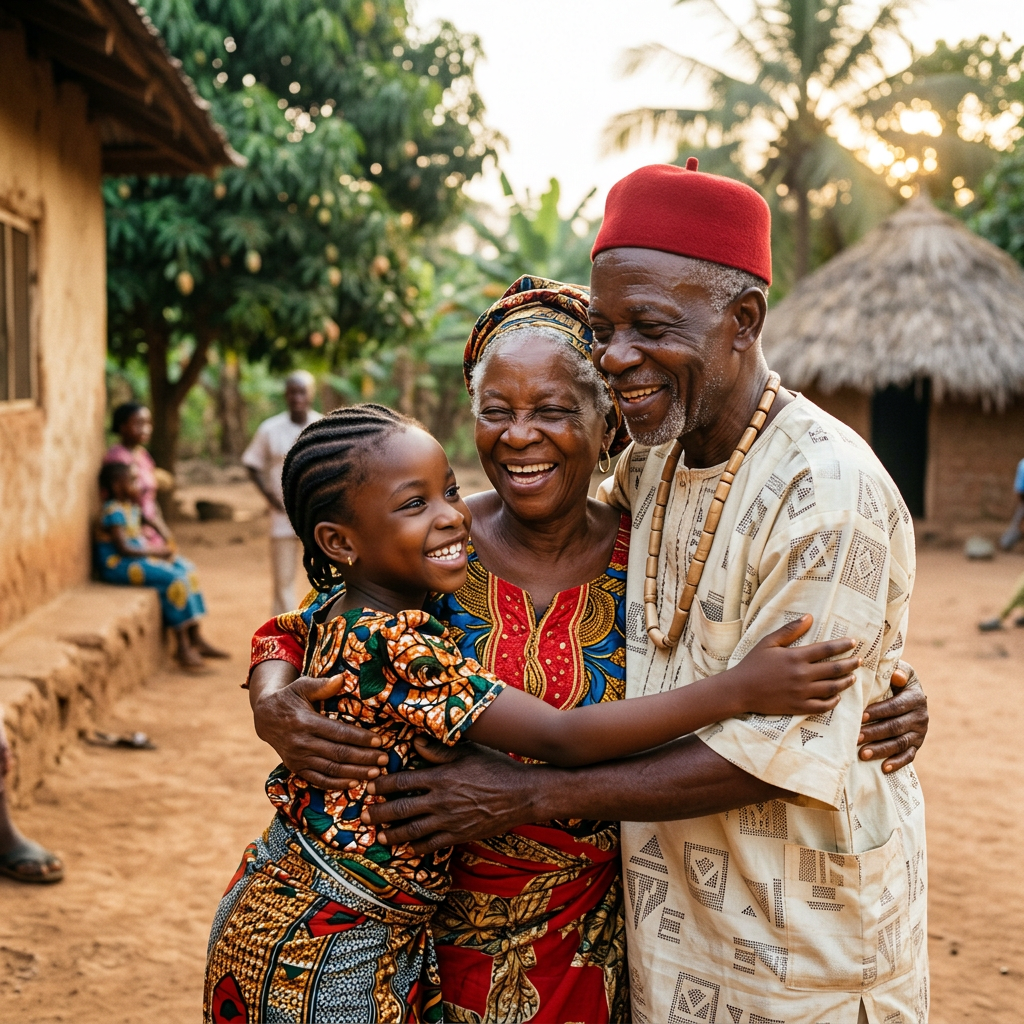
These aren’t textbook phrases. They’re the ones that make a child sound like they belong — to a family, a culture, a lineage. They’re what aunties listen for when they ask “can the children speak?”
1. Ndewo — Hello / Greetings
Pronunciation: n-DEH-woh
The universal greeting. Slightly more formal than kedu. Always respectful. Teach this first because it’s the one elders notice first — and Igbo culture is built on greeting elders properly.
When to use: walking into any room with someone older than you. Period.
2. Daalụ — Thank you
Pronunciation: DAH-loo
Practical, polite, used a hundred times a day. Stronger and warmer than thank you in English. A child who says daalụ to a grandparent unprompted is the child everyone talks about for a week.
When to use: anytime someone hands them anything, helps them, or shows kindness.
3. Biko — Please
Pronunciation: BEE-koh
The single word that turns a demand into a request. It also softens almost any sentence in Igbo. Teach kids that biko is what good manners sound like.
When to use: when asking for anything — water, food, attention, permission.
4. Ọ dị mma — It’s good / That’s fine
Pronunciation: oh dee MMAH
A multipurpose phrase. Used to accept something. To say okay. To reassure. It tells the listener “no conflict here.” Kids can use it to respond to almost any check-in: “Are you okay?” “Did you understand?” “Should we go?”
When to use: any time they would have said “okay” or “yes, that’s fine.”
5. Ahụrụ m gị n’anya — I love you
Pronunciation: ah-HOO-roo m gee n-AHN-yah
Igbo love isn’t usually said directly — it’s shown through cooking, attention, sacrifice. But for diaspora kids, who grew up hearing I love you freely, saying it in Igbo bridges both cultures. Teach them, even if it’s only said on birthdays.
When to use: at the end of phone calls with grandparents. Especially.
The habit that makes it stick
Start a habit: pick one phrase a week and use only that one in your home. By week five, all five are part of your child’s daily vocabulary — without a single lesson.
For 200+ more phrases organized by daily routines, IgboLearn’s kids mode is built exactly for this.