
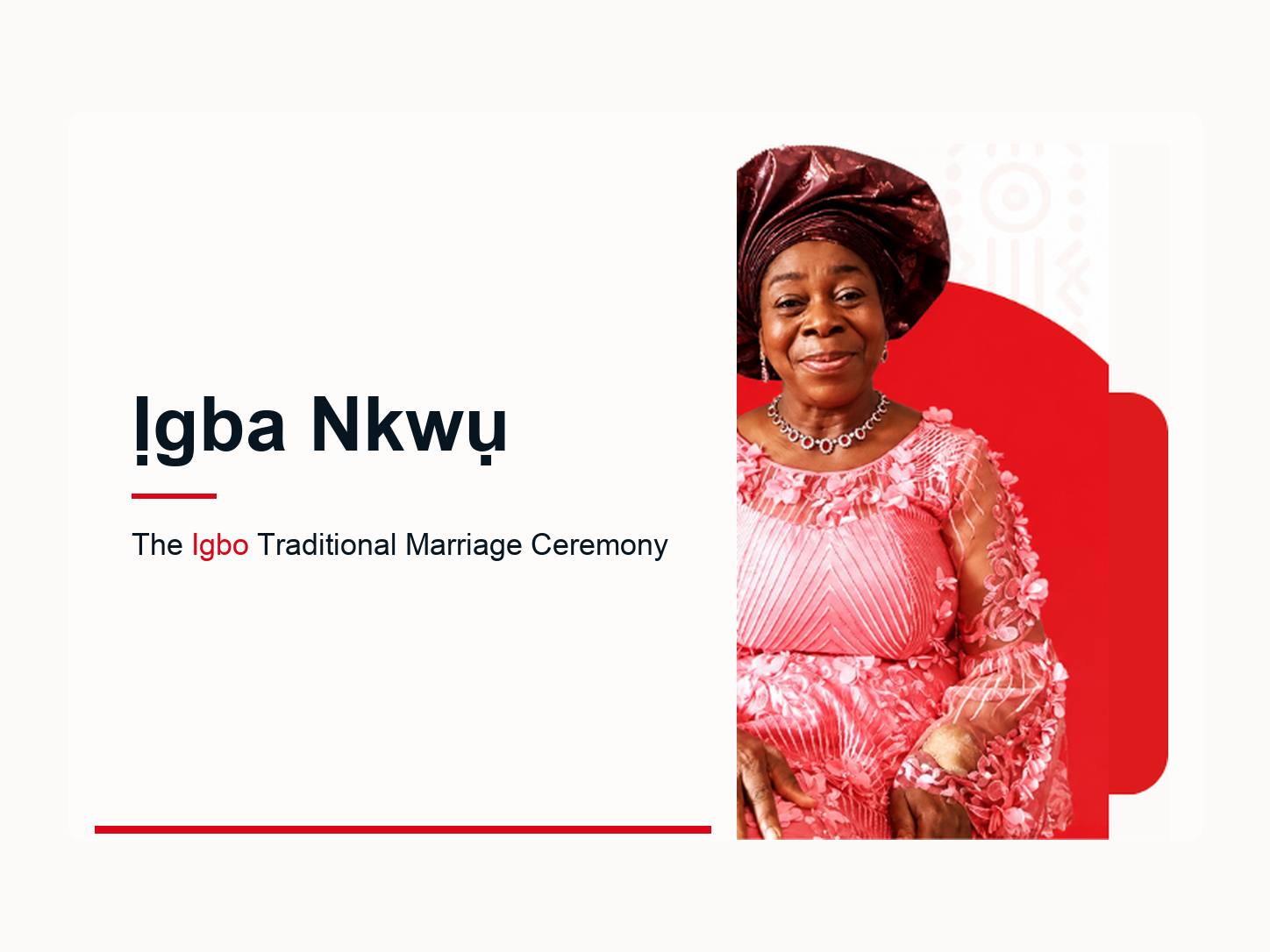
Of all the stages in an Igbo marriage, Ịgba Nkwụ is the one people mean when they say a couple is traditionally married. It is the public ceremony — the one with the photographs.
And its name is worth unpacking, because it tells you what the ceremony is built around.
What the Name Points At
Nkwụ is the palm tree. The dictionary also records mmanya ngwọ — palm wine — and diòchì, the palm wine tapper, as a trade with its own name.
So the ceremony is named after the palm, and palm wine is what sits at the centre of it. That is not decoration. In a culture where significant agreements were sealed with wine rather than paper, the wine is the ceremony.
This is why Ịgba Nkwụ is not the Igbo equivalent of a wedding reception. It is the point at which the marriage is made, witnessed and agreed.
The Word for Marriage Itself
- àlụmdinànwunyè — the formal union of two partners
Look at how it is built: àlụm plus di plus nà plus nwunyè — roughly the marrying of husband and wife. The word names both parties and the na that joins them.
Its mixed vowels are the giveaway that it is a compound, which is exactly what vowel harmony predicts.
The Vocabulary You Will Hear
Ọgọ is the word to learn if you are marrying into an Igbo family. It also turns up in a sentence the dictionary gives for welcoming: Anyị na-anabata ndị ọgọ anyị si Abakeleke! — We welcome our in-laws from Abakaliki!
That sentence is a small lesson in itself. In-laws are received formally, as a group, by name of where they came from.
Where It Sits in the Sequence
Ịgba Nkwụ is the sixth of ten stages in the lesson, and that position is the thing most outsiders get wrong. It is not the beginning of the process and it is not the end.
Before it come the finding, the formal approach at the door, the marriage list, the wine carried to the kindred, and the visits to the bride’s relatives. After it come the bride price, the invitation to know the husband’s home, the signing of documents, and the equipping of the bride’s new home.
Five stages of groundwork, then the ceremony, then four more. Igbo marriage is a process between two families, and the ceremony is one step inside it.
A Note on Variation
Almost everything specific about Ịgba Nkwụ — what is brought, who speaks, in what order, what the list contains — varies by community. Anambra is not Imo is not Abia is not Ebonyi.
So treat any single account, including this one, as a starting point rather than a rulebook. If you are preparing for one, the people to ask are the family you are marrying into.
What does not vary is the vocabulary above, and knowing it means you can follow what is being said rather than watching from outside.
Learn the Full Sequence
The Stages of Marriage in Igbo Culture lesson walks through all ten stages in order, with the Igbo name and pronunciation for each. It is the only lesson on IgboLearn that is as much about custom as about language.
👉 Learn Stages of Marriage in Igbo Culture free on IgboLearn
🎤 Practise celebration and ceremony talk in a live Igbo conversation
Related reading: a ceremony this size is also a feast, and the ten Igbo soups and what their names mean covers what is likely to be in the pots — ofe Owerri in particular is what gets cooked when someone is being honoured. For the moment the ndị ọgọ arrive, how to say welcome in Igbo has the words, and daalụ is what you owe everyone afterwards. The kinship terms are in family members in Igbo.
The ceremony is named after the palm. Nkwụ is the palm tree, and palm wine sits at the centre of the day — which is not decoration, because in a culture where significant agreements were sealed with wine rather than paper, the wine is the instrument.
No, and this is what outsiders most often get wrong. It is the sixth of ten stages — five of groundwork come before it and four more follow. Igbo marriage is a process between two families, and the ceremony is one step inside it.
No. What is brought, who speaks, in what order and what the list contains all vary by community — Anambra is not Imo is not Abia is not Ebonyi. Treat any single account as a starting point, and ask the family you are marrying into. What does not vary is the vocabulary.